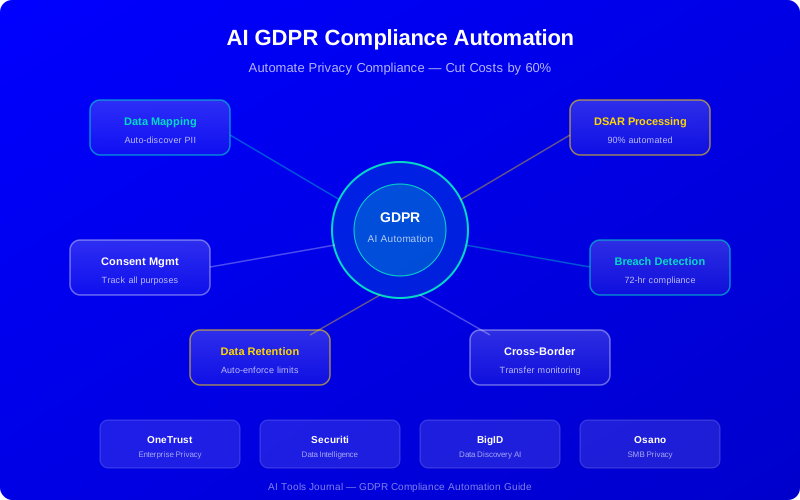
AI GDPR Compliance Automation: Cut Privacy Costs by 60%
AI automates the hardest parts of GDPR compliance—data mapping, DSAR processing, and consent management. This guide covers the top tools, implementation steps, and real cost savings.
AI reduces GDPR compliance labor costs by 60-75% compared to fully manual processes.
Automated DSAR processing handles requests in hours instead of the typical 2-4 weeks.
AI data discovery finds personal data in systems your team didn't know existed.
OneTrust, Securiti, and BigID lead the market for AI-powered GDPR compliance.
Start with automated data mapping—it's the foundation of everything else in GDPR.
GDPR is the most demanding privacy regulation on the planet. It requires you to know where every piece of personal data lives, who consented to what, and be ready to produce or delete that data within 30 days of a request. Doing this manually for thousands of data subjects across dozens of systems? Nearly impossible.
Part of our series: This guide is part of our Ultimate AI Legal Compliance Guide (2026). For a complete overview of all AI compliance tools and frameworks, start there.
AI GDPR automation tools handle the most time-consuming tasks: discovering personal data, processing subject requests, managing consent, and monitoring for breaches. Here's how to implement them effectively.
The Biggest GDPR Pain Points AI Solves
GDPR has six core requirements where AI makes the biggest difference:
Data mapping and inventory: Knowing exactly what personal data you have, where it lives, and who processes it
DSAR processing: Responding to data subject access, deletion, and portability requests within 30 days
Consent management: Tracking consent across every touchpoint, channel, and purpose
Data retention: Automatically enforcing retention schedules and deleting data past its lawful period
Breach detection: Identifying potential data breaches and assessing impact for the 72-hour notification window
Cross-border transfers: Monitoring data flows across jurisdictions and ensuring proper safeguards
AI turns weeks of manual GDPR work into hours or days. The biggest time savings come from data mapping and DSAR processing.
Top AI GDPR Compliance Platforms
1. OneTrust Privacy Management
OneTrust is the most comprehensive GDPR platform. It covers all six pain points above in a single integrated system. Over 14,000 companies use it globally.
GDPR-specific features:
AI-powered data discovery that scans 200+ data source types automatically
DSAR portal with automated fulfillment—90% of requests handled without manual intervention
Cookie consent management that auto-categorizes cookies on your websites
Data Protection Impact Assessment (DPIA) workflow with AI risk scoring
Records of Processing Activities (ROPA) generated and maintained automatically
Pricing: Enterprise plans start at $50,000/year. Mid-market plans available from $15,000/year.
2. Securiti Data Intelligence
Securiti takes a "data-first" approach. Instead of starting with compliance checklists, it starts by finding and classifying all your personal data. Then it builds compliance from that foundation.
GDPR-specific features:
PrivacyCenter.cloud for automated DSAR processing with self-service portal
AI data classification that identifies 700+ data types including PII categories
Automated data flow mapping across cloud and on-premise systems
Consent lifecycle management with granular purpose tracking
Cross-border transfer monitoring with Schrems II compliance checks
Pricing: Starting at $35,000/year for the full privacy suite.
3. BigID
BigID leads in AI-powered data discovery and intelligence. Its machine learning models find personal data that other tools miss—in unstructured data, legacy systems, and dark data repositories.
GDPR-specific features:
ML-powered data discovery across structured and unstructured data sources
Identity-aware data correlation—links scattered data back to individual data subjects
Data minimization recommendations (what personal data you can safely delete)
Automated ROPA generation from discovered data flows
Pricing: Enterprise pricing, typically $40,000-120,000/year depending on data volume.
4. Osano
Osano is the most accessible option for small-to-mid-size businesses. It covers consent management, vendor monitoring, and DSAR handling with a simpler interface and lower price point.
Best for: Companies with fewer than 1,000 employees needing essential GDPR tools. Free tier available for basic consent management.
Platform Comparison
Platform
Best For
Data Sources
Starting Price
DSAR Automation
OneTrust
Enterprise
200+
$15K/year
90% automated
Securiti
Data-heavy orgs
150+
$35K/year
85% automated
BigID
Complex data
100+
$40K/year
80% automated
Osano
SMBs
50+
Free-$8K/yr
70% automated
AI Data Mapping: The Foundation
You can't protect what you don't know about. AI data mapping is the single most important GDPR automation to implement first.
How AI Data Mapping Works
Connect data sources: AI connects to your databases, cloud services, SaaS apps, and file storage via pre-built connectors
Scan and classify: ML models scan all data, classifying it by type (name, email, address, health data, financial data, etc.)
Map data flows: AI traces how personal data moves between systems—who sends what to whom
Generate inventory: The system produces a live data inventory showing all personal data, its location, processing purpose, and legal basis
Monitor continuously: AI detects new data sources and changes, keeping your map current automatically
What AI discovers: Most companies are shocked by what AI data mapping reveals. In typical deployments, AI finds personal data in 30-50% more locations than the company knew about—shadow IT systems, legacy databases, employee-created spreadsheets, and third-party systems with undocumented data sharing.
DSAR Automation
Data Subject Access Requests (DSARs) are the most operationally expensive GDPR requirement. Each request takes 10-20 hours to fulfill manually. Companies receiving 50+ DSARs per month spend over $100,000 annually on manual processing alone.
The AI DSAR Workflow
Request intake: Data subjects submit requests through a self-service portal (no email!).
Identity verification: AI verifies the requester's identity using multi-factor authentication
Data search: AI searches all connected systems for the subject's personal data
Compilation: Results are compiled, deduplicated, and organized by data category
Redaction: AI automatically redacts third-party personal data from the response
Review: The DPO reviews the compiled response (typically 15-30 minutes)
Delivery: Approved response is securely delivered to the data subject
Time savings: From 10-20 hours manual to 2-4 hours with AI (including the DPO review time). Cost drops from $2,000-3,000 per request to $300-500.
AI Consent Management
GDPR requires specific, informed, freely given consent for each processing purpose. Managing consent across websites, apps, email, phone, and in-person interactions is a nightmare without AI.
What AI Consent Management Does
Cookie scanning: AI crawls your websites and automatically categorizes every cookie by purpose
Consent tracking: Records exactly when, where, and for what purpose each data subject consented
Preference centers: Self-service portals where users can manage their consent preferences
Expiration management: Flags consents approaching expiration for renewal campaigns
Withdrawal processing: Instantly propagates consent withdrawal across all connected systems
Implementation Guide
Step 1: Start with Data Mapping (Weeks 1-4)
Deploy AI data discovery first. You need a complete picture of your personal data before automating anything else. Budget 2-4 weeks for initial scanning and classification.
Step 2: Automate DSARs (Weeks 3-8)
Once data mapping is complete, set up automated DSAR processing. This has the highest immediate ROI because each automated request saves 15+ hours of manual work.
Step 3: Implement Consent Management (Weeks 6-12)
Deploy cookie consent banners and preference centers. Connect consent records to your processing activities. Ensure all marketing systems check consent before processing.
Turn on ongoing data discovery, breach detection, and retention enforcement. Set up dashboards for your DPO and compliance team. Configure automated alerts for compliance drift.
AI GDPR automation typically reduces compliance costs by 60-80%, with the platform cost included in the AI figure.
Common Pitfalls
Skipping the data inventory. Every GDPR automation depends on knowing where your data is. Don't automate DSARs or consent before completing data mapping.
Over-relying on AI for decisions. AI flags and recommends. Humans (your DPO) must approve DSAR responses, DPIA conclusions, and breach notifications. Keep humans in the loop.
Ignoring legacy systems. The most dangerous personal data often lives in old systems that are hardest to scan. Make sure your AI tool has connectors for legacy databases.
Forgetting employee data. GDPR applies to employee personal data too, not just customers. Include HR systems in your data mapping scope.
Not testing breach response. Run tabletop exercises to test your AI-assisted breach detection and 72-hour notification process before a real incident occurs.
AI automates 60-80% of GDPR tasks, but human oversight is still required. Data Protection Officers must review AI-generated data inventories, approve DSAR responses before sending, and make judgment calls on legitimate interest assessments. AI handles the heavy lifting so your DPO can focus on decisions that require human judgment.