AI Keyword Clustering Tools: Group Keywords Like a Pro
Stop targeting keywords one at a time. AI keyword clustering tools group hundreds of keywords into content-ready clusters that boost topical authority and rankings.
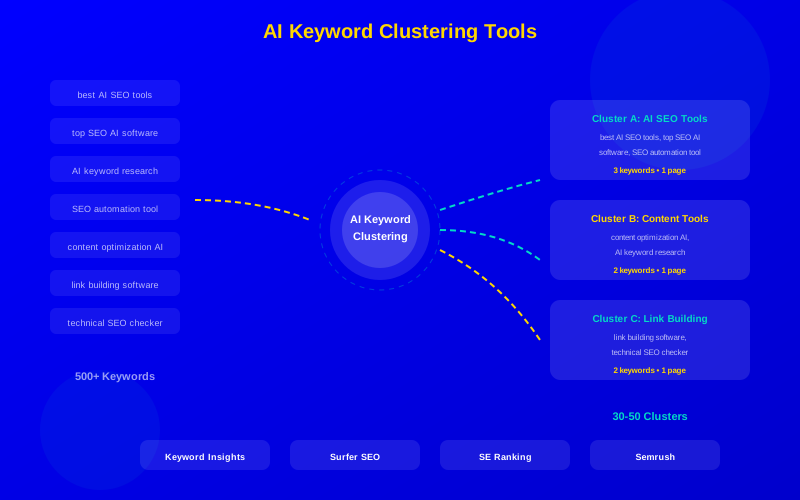
AI keyword clustering groups hundreds of keywords into topic-based clusters in minutes.
Cluster-based content strategies rank 3x faster than single-keyword targeting.
The top tools are Keyword Insights, Surfer SEO, and SE Ranking's Keyword Grouper.
AI uses SERP analysis—not just word matching—to determine which keywords belong together.
Start with 500-1,000 keywords and let AI organize them into 20-50 actionable clusters.
Targeting one keyword per page is an outdated strategy. In 2026, search engines understand topics, not just keywords. AI keyword clustering tools group hundreds of related keywords into clusters that map to single pages—building the topical authority Google rewards.
Part of our series: This guide is part of our Ultimate AI SEO Tools Guide (2026). For a complete overview of all AI SEO tools, start there.
This guide shows you how keyword clustering works, compares the best tools, and walks you through building a cluster-based content strategy.
What Is AI Keyword Clustering?
Keyword clustering uses AI to group keywords that share the same search intent. Instead of guessing which keywords belong together, AI analyzes the actual search results (SERPs) for each keyword. If two keywords show the same top-ranking pages, they belong in the same cluster.
Here's a simple example:
Keywords
Same Top Results?
Cluster
best AI SEO tools
Yes — 7/10 overlap
Cluster A: AI SEO Tools
top AI tools for SEO
Yes — 8/10 overlap
Cluster A: AI SEO Tools
AI SEO software comparison
Yes — 6/10 overlap
Cluster A: AI SEO Tools
how to use AI for SEO
No — different results
Cluster B: AI SEO How-To
AI SEO tutorial 2026
Yes — matches Cluster B
Cluster B: AI SEO How-To
This SERP-based approach is more accurate than grouping keywords by words alone. The phrase "apple nutrition facts" and "apple store hours" both contain "apple" but target completely different intents.
Why Clustering Beats Single-Keyword Targeting
Higher rankings: Pages targeting a cluster of 10-20 keywords rank for more total queries
No cannibalization: You won't accidentally create competing pages for similar keywords
Better content: Clusters tell you exactly what subtopics to cover on each page
Efficient planning: 1,000 keywords become 30-50 content pieces instead of 1,000 thin pages
AI clustering combines related keywords into single pages, eliminating cannibalization and boosting rankings.
Best AI Keyword Clustering Tools (2026)
1. Keyword Insights
Keyword Insights is the dedicated leader in AI keyword clustering. Upload a CSV of keywords, and it groups them by analyzing live SERP data. It also classifies each cluster by search intent (informational, commercial, transactional) and suggests content briefs.
Key features:
Processes up to 100,000 keywords per batch
SERP-based clustering with adjustable similarity threshold
Automatic intent classification for each cluster
Content brief generation with recommended headings and topics
Hub-and-spoke visualization for topic mapping
Pricing: $58-238/month depending on keyword credits.
2. Surfer SEO Keyword Research
Surfer combines keyword clustering with content optimization in one platform. Its Topic Map feature builds visual cluster maps from a seed keyword, showing you exactly what articles to write and how to link them together.
Key features:
Visual topic maps with pillar and cluster pages
Integrated content editor for cluster-based writing
Internal link suggestions between clustered content
Real-time content scoring for each cluster topic
Pricing: $69-219/month (clustering included in all plans).
3. SE Ranking Keyword Grouper
SE Ranking's keyword grouping tool is built into their affordable SEO platform. It clusters keywords by SERP similarity and integrates results directly into their rank tracker and content tool.
Automatic sub-cluster detection within large groups
Direct integration with rank tracking and content tools
Competitive analysis showing which clusters competitors dominate
Pricing: $44-191/month (clustering included).
4. Semrush Keyword Manager
Semrush uses its Keyword Manager tool for clustering. It groups keywords by topic using NLP analysis combined with SERP overlap detection. Being part of the Semrush ecosystem means seamless integration with their 50+ SEO tools.
Pricing: $130-500/month (part of Semrush suite).
Tool Comparison
Tool
Max Keywords
Method
Intent Classification
Content Briefs
Price
Keyword Insights
100,000
SERP overlap
Yes
Yes
$58-238/mo
Surfer SEO
10,000
NLP + SERP
Yes
Yes
$69-219/mo
SE Ranking
50,000
SERP overlap
No
No
$44-191/mo
Semrush
10,000
NLP + SERP
Yes
Limited
$130-500/mo
How to Cluster Keywords: Step-by-Step
Here's a practical workflow you can follow today:
Collect seed keywords. Start with 5-10 broad topics in your niche. Use Semrush or Ahrefs to expand each into 100-200 related keywords.
Clean your keyword list. Remove duplicates, branded terms you won't target, and keywords with zero search volume.
Upload to your clustering tool. Keyword Insights and SE Ranking accept CSV uploads. Surfer works from seed keywords directly.
Set your threshold. A threshold of 3 (3 matching URLs in top 10) creates broad clusters. A threshold of 5 creates tighter, more focused clusters. Start with 3-4.
Review and adjust. AI isn't perfect. Merge tiny clusters that make sense together. Split oversized clusters that cover multiple intents.
Assign primary keywords. For each cluster, pick the highest-volume keyword as the primary target. The rest become secondary keywords for that page.
Create content briefs. Use your clusters to plan articles. Each cluster = one page with clear headings and subtopics.
The AI keyword clustering workflow turns a large keyword list into actionable content plans in five steps.
Advanced Clustering Strategies
Hub-and-Spoke Content Architecture
The most effective way to use keyword clusters is the hub-and-spoke model. One pillar page targets the broadest cluster. Supporting pages target narrower clusters that link back to the pillar.
For example, if you're in the AI tools space:
Hub (pillar): "Ultimate AI SEO Tools Guide" — targets the broadest cluster
Spoke 1: "AI Keyword Clustering Tools" — targets a specific sub-cluster
Spoke 2: "AI Content Gap Analysis Tools" — targets another sub-cluster
Spoke 3: "AI Technical SEO Audit Tools" — targets another sub-cluster
Every spoke links to the hub. The hub links to every spoke. This creates a tight topical network that search engines love.
Competitive Cluster Analysis
Use clustering to find gaps in competitor strategies. Export your competitors' ranking keywords from Semrush or Ahrefs, cluster them alongside your own, and identify clusters where competitors rank but you don't. These are your highest-opportunity targets.
Seasonal and Trending Clusters
Some keyword clusters peak at specific times. AI tools can identify seasonal patterns and suggest when to publish. For example, "back to school AI tools" clusters peak in July-August. Plan content 2-3 months ahead of seasonal peaks for best results.
Common Keyword Clustering Mistakes
Clusters too broad: A cluster with 100+ keywords probably covers multiple intents. Split it.
Ignoring low-volume clusters: Small clusters of 3-5 keywords often have the least competition and highest conversion rates.
Not acting on clusters: Clustering is only useful if you create content for each cluster. Prioritize by traffic potential and business value.
Set-and-forget: Search intent changes. Re-cluster every 3-6 months to stay current.
Skipping manual review: AI makes mistakes. Always review clusters before building content plans.
Ready to start clustering? Pick the tool that fits your budget—Keyword Insights for dedicated clustering, Surfer SEO if you also need content optimization, or SE Ranking for an affordable all-in-one. Upload 500 keywords today and see how AI transforms your content strategy.
keyword clusteringAI SEOtopic clusterskeyword groupingcontent strategySEO automationsemantic SEOkeyword research
Frequently Asked Questions
Keyword clustering is the process of grouping related keywords that can be targeted by a single page. Instead of creating separate pages for "best running shoes," "top running shoes 2026," and "running shoe reviews," AI determines these should all be on one page. This prevents keyword cannibalization and builds stronger topical signals.