AI Patient Monitoring Systems: Catch Problems Before They Happen
AI patient monitoring systems detect deterioration 6-12 hours before traditional alarms. This guide reviews the best platforms, proven outcomes, and implementation steps.
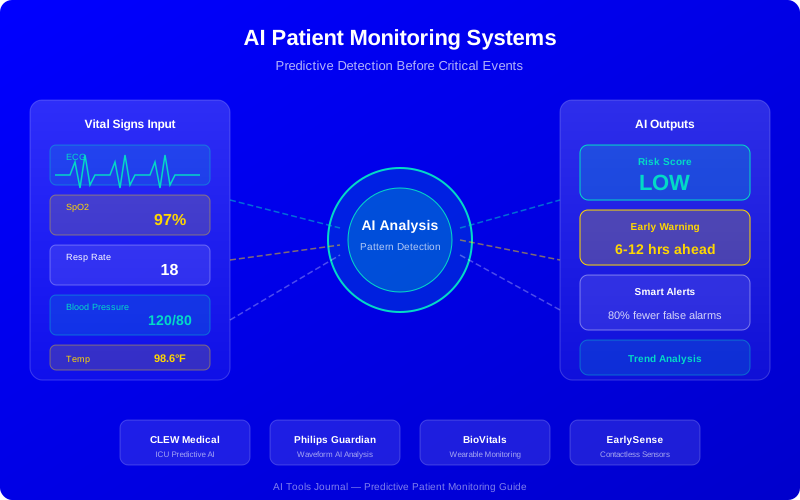
AI monitoring systems predict patient deterioration 6-12 hours before traditional threshold-based alarms.
False alarm rates drop from 80-95% to 15-25% with AI-powered monitoring.
Leading platforms include CLEW Medical, Philips IntelliVue AI, and BioVitals by Biofourmis.
AI analyzes multiple vital signs together to detect subtle patterns humans miss.
Implementation starts with one ICU or step-down unit and expands based on measured outcomes.
A patient's heart rate drifts up slightly. Respiratory rate increases by two breaths per minute. Temperature rises half a degree. Each change is within normal limits. But together, they signal sepsis 8 hours before any traditional alarm would fire. That's what AI patient monitoring catches.
Part of our series: This guide is part of our Ultimate AI Patient Care Guide (2026). For a complete overview of all AI patient care tools, start there.
This guide covers how AI monitoring works, reviews the leading platforms, and gives you a practical implementation roadmap.
How AI Patient Monitoring Works
Traditional bedside monitors use simple rules: heart rate above 120? Alarm. Blood pressure below 90? Alarm. This single-threshold approach creates two problems. It misses subtle multi-variable deterioration. And it generates so many false alarms that nurses start ignoring them.
AI monitoring takes a fundamentally different approach. It builds a baseline model for each patient, then watches for deviations across all vital signs simultaneously.
The AI Monitoring Process
Data collection: AI ingests continuous streams from ECG, pulse oximetry, blood pressure, respiratory rate, and temperature sensors
Baseline learning: Over the first few hours, AI establishes what's "normal" for this specific patient—not population averages
Pattern detection: AI algorithms compare real-time data against the patient's baseline and known deterioration patterns
Risk scoring: A clinical risk score updates every few minutes, visible to nurses and physicians
Smart alerting: Alerts trigger only when the combined risk exceeds clinical thresholds, with clear explanations
AI monitoring outperforms traditional monitoring across every metric, with dramatically fewer false alarms and hours more advance warning.
Leading AI Patient Monitoring Platforms
1. CLEW Medical
CLEW Medical leads in ICU predictive analytics. Its AI models predict respiratory failure, hemodynamic instability, and kidney injury hours before clinical deterioration.
Key capabilities:
Predicts respiratory failure 4-6 hours ahead with 87% accuracy
Hemodynamic instability prediction with a 0.85 AUC score
Integrates with Philips, GE, and Mindray monitors
Risk scores update every 15 minutes on nurse station dashboards
FDA-cleared for clinical use in the United States
Best for: Hospital ICUs and step-down units with 20+ beds.
2. Philips IntelliVue with Guardian AI
Philips combines its market-leading bedside monitors with cloud-based AI. If you already use IntelliVue monitors, adding the AI layer is a software upgrade—no new hardware needed.
Key capabilities:
Waveform analysis of ECG, SpO2, and respiratory patterns
Early deterioration detection across all monitored vital signs
Mobile alerts to nurses via smartphones and smartwatches
Integration with Philips HealthSuite digital platform
Best for: Hospitals already using Philips monitoring infrastructure.
3. BioVitals by Biofourmis
Biofourmis BioVitals uses wearable biosensors for continuous monitoring—both in-hospital and post-discharge. It's the leader in remote patient monitoring (RPM) with AI.
Key capabilities:
Continuous monitoring via wrist-worn biosensors
Heart failure decompensation prediction 14 days ahead
Post-discharge monitoring that extends hospital-quality surveillance home
FDA-cleared prescription digital therapeutic platform
Best for: Post-discharge monitoring, heart failure programs, and RPM initiatives.
4. EarlySense (now Hillrom)
EarlySense uses contactless monitoring—a sensor under the mattress tracks heart rate, respiratory rate, and movement without any wearables. The AI layer detects subtle changes in breathing patterns and heart rate variability.
Best for: Med-surg floors where wearable compliance is challenging.
Platform Comparison
Platform
Setting
Sensor Type
Prediction Window
EHR Integration
FDA Status
CLEW Medical
ICU
Bedside monitors
4-8 hours
Epic, Cerner
Cleared
Philips Guardian
ICU, Step-down
IntelliVue monitors
2-6 hours
Epic, Cerner
Cleared
BioVitals
Hospital + Home
Wearable biosensor
Up to 14 days
Epic, Cerner
Cleared
EarlySense
Med-Surg
Under-mattress
2-4 hours
Epic, Cerner
Cleared
Proven Clinical Outcomes
AI monitoring isn't theoretical. Published studies show measurable improvements:
35% reduction in adverse events — Mount Sinai Health System using predictive monitoring across 4 ICUs
44% fewer rapid response calls — Mercy Health using AI early warning scores on general wards
20% lower ICU mortality — CLEW Medical published results from 3,200 ICU patients
86% reduction in false alarms — Philips AI filtering at Johns Hopkins Hospital
2.5 days shorter ICU stays — AI-guided interventions at Cedars-Sinai Medical Center
"AI monitoring changed how our nurses work. Instead of drowning in false alarms, they now get actionable alerts that actually save lives. We caught 3 sepsis cases last month that would have been missed with traditional monitoring."
— ICU Clinical Director, Mount Sinai Health System
Implementation Roadmap
Here's how to bring AI monitoring to your facility:
Phase 1: Assessment (Weeks 1-4)
Audit current monitoring infrastructure and alarm burden
Calculate false alarm rates and nurse response times
Identify the highest-acuity units for pilot deployment
Evaluate vendor options based on your existing equipment
Phase 2: Pilot (Weeks 5-16)
Deploy AI monitoring in one unit (typically 15-30 beds)
Run AI in "shadow mode" first—generating alerts without clinical action
Train nursing staff on AI alert interpretation (2-4 hours per nurse)
Switch to "live mode" after 2 weeks of shadow validation
Phase 3: Measure (Weeks 12-20)
Compare adverse events, rapid response calls, and mortality with baseline
Survey nurses on alarm fatigue and alert quality
Calculate cost savings from prevented adverse events
Document findings for leadership and regulatory review
Phase 4: Expand (Months 6-12)
Roll out to additional units based on pilot results
Add post-discharge monitoring for high-risk patients
Integrate AI alerts into EHR clinical workflows
Explore additional AI applications in medication and coordination
A phased implementation approach takes AI monitoring from pilot to hospital-wide deployment in about 12 months.
Cost and ROI Analysis
AI monitoring systems range from $50-200 per bed per month, depending on the platform and features. Here's how the ROI works:
Metric
Without AI
With AI
Savings
Adverse events per 1,000 patients
45
29
$1.2M/year
Rapid response calls/month
120
67
$180K/year
Average ICU stay
5.2 days
4.1 days
$960K/year
Nurse overtime (alarm response)
280 hrs/month
85 hrs/month
$350K/year
For a 50-bed ICU at $150/bed/month ($90,000/year), the typical ROI is 10-15x the annual cost when you factor in reduced adverse events, shorter stays, and decreased overtime.
Choosing the Right System
Pick your AI monitoring platform based on your biggest need:
Already have Philips monitors? Add Philips Guardian AI — lowest implementation effort
Need ICU-specific predictions? Choose CLEW Medical — strongest published evidence
Need hospital-to-home continuity? Pick BioVitals by Biofourmis — best RPM capabilities
Want contactless monitoring? Go with EarlySense — no wearables needed
Start with a vendor demo and ask for published outcome data from similar facilities. Request a 30-day shadow mode trial before committing. The best vendors will let you validate their system with your own patients and staff.
Traditional monitors fire when any single vital sign crosses a threshold. AI analyzes patterns across multiple vital signs simultaneously, only alerting when the combined pattern indicates real clinical risk. This reduces false alarms by 70-80%, so nurses respond to alerts that actually matter.