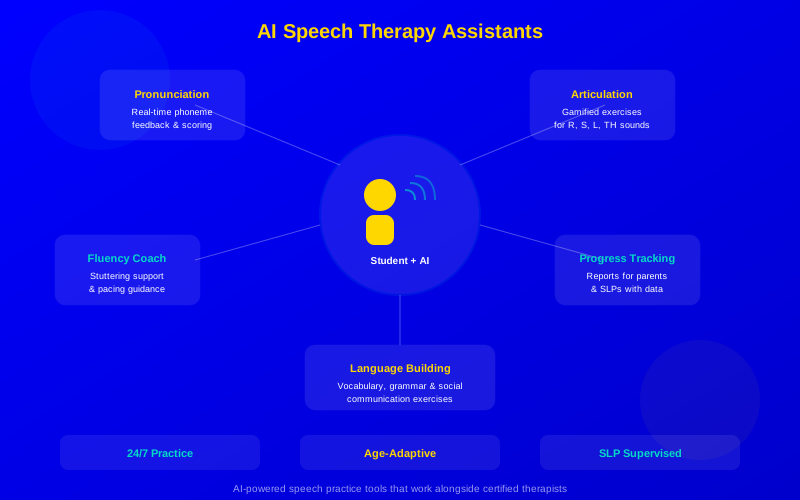
AI Speech Therapy Assistants: Help Every Student Find Their Voice
AI speech therapy tools give students more practice time and personalized feedback. Compare the best AI speech assistants for schools and clinics in 2026.
AI speech therapy assistants provide unlimited practice time between clinic sessions.
Top tools can detect articulation errors, track progress, and adjust difficulty automatically.
AI doesn't replace speech-language pathologists (SLPs)—it gives them superpowers.
Students using AI practice tools show 30-40% faster progress on articulation goals.
Most tools are FERPA-compliant and designed for school and clinic use.
Speech-language pathologists are stretched thin. The average school SLP manages 50-80 students, with only 20-30 minutes per session, once or twice a week. Students need daily practice to make progress—but there's no one to supervise it.
AI speech therapy assistants fill this gap. They give students unlimited practice time with instant feedback, track progress automatically, and free SLPs to focus on the students who need them most. This guide covers the best tools, how they work, and how to use them effectively.
Why AI Speech Therapy Tools Matter
AI tools multiply practice time from under 1 hour to 3-5 hours weekly, accelerating student progress by 30-40%
The math is simple. Students need repetition to develop speech skills. An SLP can provide 40-60 minutes per week. AI tools add 2-4 more hours of guided practice. More practice means faster progress.
ADVERTISEMENT
According to the American Speech-Language-Hearing Association (ASHA), there are over 3.4 million students receiving speech services in U.S. schools. The SLP-to-student ratio continues to grow, making technology-assisted practice essential.
Here's what AI speech therapy tools provide:
ADVERTISEMENT
Feature
Without AI
With AI
Impact
Practice time
40-60 min/week
3-5 hours/week
4-5x more practice
Feedback speed
Next session (days later)
Instant
Immediate correction
Progress tracking
Manual data sheets
Automatic + visual
Real-time insights
Home practice
Paper worksheets
Interactive games
Higher engagement
SLP time per student
20-30 min direct
20-30 min + AI data
Better-informed sessions
"AI speech tools don't replace me—they make my 30 minutes with each student so much more effective. I walk in with data about their practice all week, instead of starting from scratch."
— Jennifer Walsh, School SLP, California
Best AI Speech Therapy Tools Compared
Here are the top AI speech therapy platforms in 2026, with honest assessments of each:
Speech Blubs uses video modeling—real children demonstrating sounds—combined with AI speech recognition. Kids watch a video of a child saying a word, then practice saying it themselves. AI listens and gives feedback.
ADVERTISEMENT
Key Features
Video modeling: Kids learn from watching peers, not just adults
Phoneme detection: AI identifies which sounds are produced correctly and which need work
Adaptive difficulty: Activities get harder as the student improves
Parent dashboard: Parents see practice time and progress at home
SLP reports: Detailed data for IEP goal tracking
Speech Blubs works best for children working on initial consonant sounds, final consonant sounds, and vowel production. It's not designed for complex fluency disorders or voice therapy.
Amplicaty: Best for Schools
Best for: K-12 school-based speech programs
ADVERTISEMENT
Amplicaty was built specifically for school SLPs. It connects to IEP goals, tracks progress against benchmarks, and generates the reports that schools need for compliance.
Key Features
IEP goal alignment: Practice activities map directly to each student's goals
Caseload management: SLPs manage their entire caseload from one dashboard
AI speech scoring: 90% accuracy on common articulation targets
Progress reports: Auto-generated reports for IEP meetings
Multilingual support: English and Spanish speech activities
If you're a school SLP managing 50+ students, Amplicaty gives you the tools to stay organized while your students get daily AI-guided practice.
Expressable offers real SLP teletherapy sessions plus AI-powered practice between sessions. This combination delivers the best results because the SLP guides the treatment plan while AI handles the repetition.
Key Features
Live SLP sessions: 25-minute teletherapy with licensed SLPs
AI practice app: Daily exercises customized by the student's SLP
Highest accuracy: 92% articulation detection—the best in the market
All disorders: Articulation, fluency, language, voice, and pragmatic social skills
Expressable is the premium option. It costs more, but the combination of human therapy and AI practice delivers the fastest results.
ADVERTISEMENT
How AI Speech Detection Works
AI speech detection follows a four-step pipeline from audio capture to instant student feedback
Understanding how the technology works helps SLPs use it effectively:
Step 1: Audio Capture
The student speaks into a device microphone. Good microphone quality matters—noisy environments reduce accuracy. Use a quiet room and a device with a decent microphone.
ADVERTISEMENT
Step 2: Speech-to-Phoneme Conversion
AI converts the audio waveform into individual phonemes (speech sounds). This is where the AI model does the heavy lifting—detecting subtle differences between correct and incorrect production.
Step 3: Comparison to Target
AI compares the student's phoneme production to a model of correct production. It identifies which sounds match and which don't. For example, if a student says "wabbit" instead of "rabbit," AI detects the /w/ substitution for /r/.
ADVERTISEMENT
Step 4: Feedback
The tool provides immediate, age-appropriate feedback. For young children, this might be an animated character celebrating. For older students, it might be a visual showing the correct mouth position.
How to Set Up AI Speech Therapy in Your School
Getting started with AI speech tools takes planning. Here's a step-by-step guide:
ADVERTISEMENT
Step 1: Assess Your Needs
How many students are on your speech caseload?
What are the most common therapy targets? (Articulation? Language? Fluency?)
What devices do students have access to? (School tablets? Personal devices?)
Do you need home practice functionality?
Step 2: Choose Your Tool
Your Situation
Best Tool
Why
Young students (3-8), articulation focus
Speech Blubs
Video modeling + gamification
School SLP with large caseload
Amplicaty
IEP integration + caseload tools
Best quality, budget flexible
Expressable
Human SLP + AI combo
District-wide rollout
Presence Learning
Scalable + admin tools
Simple drill practice
Articulation Station Pro
Affordable + focused
Step 3: Pilot With a Small Group
Start with 5-10 students. Run the pilot for 6-8 weeks. Track:
Student engagement (how often they practice)
Progress on therapy goals compared to non-AI students
SLP time savings
Parent feedback
Step 4: Train and Scale
Once your pilot shows results, expand to your full caseload. Train other SLPs in your district. Most vendors offer free onboarding sessions.
ADVERTISEMENT
Tips for SLPs Using AI Speech Tools
Review AI data before sessions: Check what the student practiced all week so you can target remaining difficulties
Set specific practice targets: Don't just assign "practice." Assign specific sounds, word positions, and difficulty levels
Use AI data for IEP goals: AI-tracked progress data makes IEP meetings faster and more data-driven
Involve parents: Show parents how to support home practice with the app
Don't over-rely on AI scores: AI detection isn't perfect. Use your clinical judgment alongside AI data
Current Limitations to Know
AI speech therapy tools are impressive, but they have real limitations:
Limitation
Impact
Workaround
Background noise sensitivity
Reduced accuracy in noisy classrooms
Use headphones with microphones
Accent and dialect bias
May flag dialectal variations as errors
Choose tools with dialect settings
Limited fluency analysis
Stuttering detection is still basic
Use AI for articulation; manual for fluency
No pragmatic language support
Can't assess social communication
AI handles speech sounds; SLP handles social skills
Young children's variability
Very young speakers are inconsistent
Use with ages 4+ for best results
"AI tools are my most valuable assistant. But I always remind parents and teachers: AI practices sounds. The SLP handles the thinking—assessment, treatment planning, and the human connection students need."
ADVERTISEMENT
— Dr. Robert Martinez, School District SLP Lead, Texas
Getting Started
Ready to bring AI speech therapy to your students? Here's your action plan:
This week: Sign up for free trials of Speech Blubs and Amplicaty
Try it yourself: Test the speech recognition with your own voice first
Pick 5 students: Choose students with articulation goals who would benefit from extra practice
Run a 6-week pilot: Track practice time and compare progress to your typical timelines
Share results: Present pilot data to your administration for expanded funding
speech therapyAI for special educationspeech-language pathologySLP toolsarticulation practicelanguage developmentassistive technology
Frequently Asked Questions
No, and they shouldn't. AI tools are practice assistants, not clinicians. An SLP diagnoses speech disorders, creates treatment plans, and makes clinical decisions. AI extends therapy by giving students homework practice with instant feedback. Think of AI as a very patient practice partner that never gets tired.