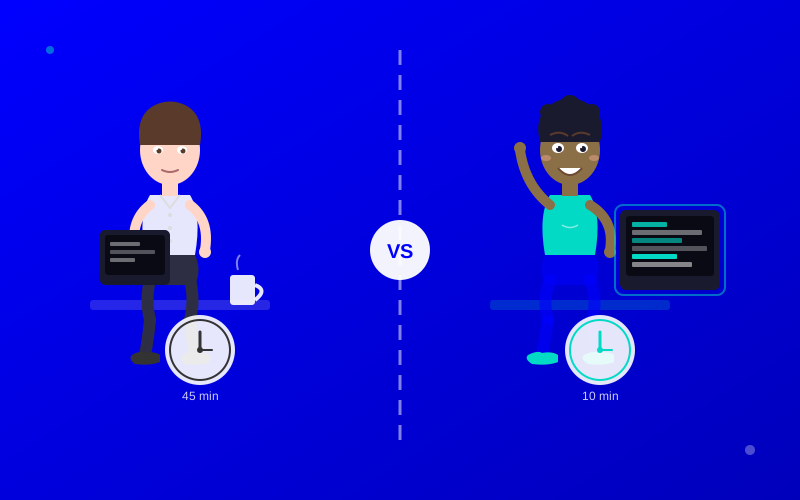
The debate isn't whether AI code generators are useful — 92% of developers have already tried them. The real question is: where do they outperform traditional coding, and where do they fall short?
This comparison breaks down AI-assisted vs. traditional coding across every metric that matters: speed, quality, security, cost, and learning.
Head-to-head comparison across key development metrics
Speed: AI Wins Decisively
For routine coding tasks, AI is dramatically faster. Boilerplate generation, CRUD operations, test scaffolding, and API integrations that take 15-30 minutes manually happen in seconds with AI.
Task Type
Traditional Time
AI-Assisted Time
Speed Gain
REST API endpoint
25-35 min
5-8 min
4x faster
Unit test suite
30-45 min
8-12 min
3.5x faster
Database model
15-20 min
3-5 min
4x faster
React component
20-30 min
5-10 min
3x faster
Complex algorithm
45-90 min
40-80 min
1.1x faster
Notice the last row. For complex algorithmic work, AI provides minimal speedup. This is where human expertise remains essential.
Code Quality: It Depends
AI-generated code quality varies dramatically by task type. For well-known patterns with millions of training examples, AI produces clean, idiomatic code. For novel problems or project-specific patterns, quality drops sharply.
Quality ratings from code review studies (scale: 0-100)
"AI code generators are like a GPS for coding. Great for well-traveled roads. Terrible when you need to go off-road."
— Martin Fowler, Software Architecture Author
Security: Traditional Has the Edge
Security is where AI coding tools need the most caution. AI models can suggest code with known vulnerabilities because they've trained on vulnerable code. They don't inherently understand security contexts.
SQL injection: AI sometimes generates unparameterized queries
XSS vulnerabilities: Unsanitized output in web frameworks
Hardcoded secrets: AI may generate placeholder API keys that look real
Outdated dependencies: Suggestions may use deprecated or vulnerable libraries
When to Use What
Scenario
Best Approach
Why
Prototyping
AI-assisted
Speed matters most, polish later
Production security-critical code
Traditional + AI review
Human security review is essential
Learning a new language
AI-assisted
See idiomatic patterns immediately
System architecture
Traditional
AI lacks project-wide context
Test generation
AI-assisted
AI excels at edge case coverage
Code refactoring
AI-assisted
AI sees patterns humans miss
The Verdict
AI code generators and traditional coding aren't competing — they're complementary. The best developers in 2026 use AI for what it's good at (speed, patterns, boilerplate) and rely on human expertise for what AI struggles with (architecture, security, novel problems).
The winning workflow: let AI generate the first draft, then apply human judgment for review, security, and architectural decisions.
AI codingtraditional codingdeveloper workflowproductivitycomparison
Frequently Asked Questions
Not necessarily. AI code follows common patterns well. But it can introduce subtle bugs. The quality depends on how well you review and test it. Good developers using AI produce excellent code. The key is never skipping code review.