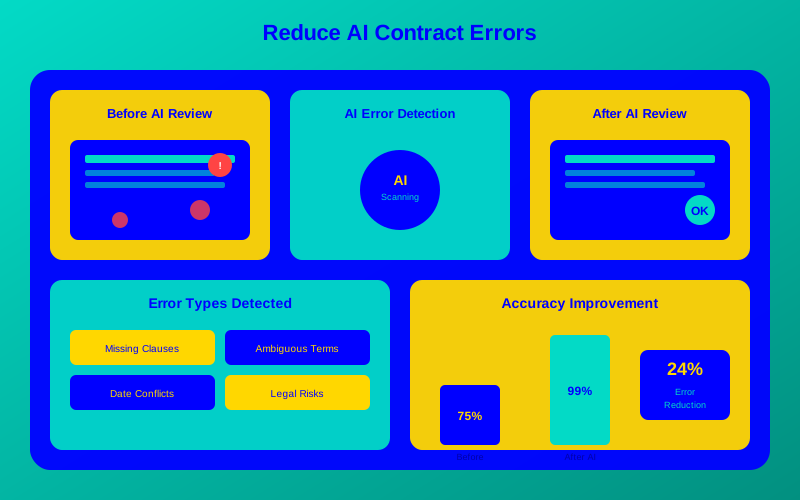
According to World Commerce & Contracting, poor contract management costs organizations 9% of annual revenue. AI contract review catches errors before they become expensive disputes.
This guide covers how AI identifies contract risks and how to implement review automation.
Studies from Stanford Law show AI contract review finds 30% more issues than human-only review in controlled tests. The AI never gets tired, doesn't rush before deadlines, and applies consistent standards.
Common catches include:
Definition inconsistencies: Terms defined but not used consistently
Missing clauses: Standard protections that got dropped
Unusual language: Deviations from market standard terms
Risk allocation: Liability caps that don't match your policy
Conflicting provisions: Clauses that contradict each other
"Kira caught a definition inconsistency that would have cost us $2M. The seller's definition of 'Intellectual Property' excluded trade secrets in one section but included them in another. We would have signed without catching it."
— M&A Associate, Law Firm
Playbook Comparison: Automated Policy Enforcement
LawGeex compares incoming contracts against your approved terms and flags deviations. Per their published benchmarks, it analyzes contracts in seconds with 94% accuracy.
When professionals report breaking even on AI tool investment
Step-by-Step Implementation
Audit your current workflow: Map where you spend time and identify bottlenecks.
Select the right tool: Match your biggest pain point to a tool's core strength.
Start small: Run a 2-week pilot on one project or task type.
Measure and compare: Compare pilot results to your pre-AI baseline.
Scale what works: Expand successful workflows to your full workload.
☐ Workflow bottlenecks identified and prioritized
☐ Tool selected and trial account created
☐ Pilot project and timeline defined
☐ Success metrics established
☐ Team onboarding plan in place
☐ Post-pilot review date scheduled
Take Action This Week
The gap between AI-enabled legal pros professionals and those using traditional methods is growing every quarter. Don't wait for the perfect moment — start with one tool, one task, and one week of focused experimentation.
AI catches missing clauses, inconsistent defined terms, unusual liability caps, non-standard indemnification, missing insurance requirements, and conflicting provisions. It also flags ambiguous language that could be interpreted multiple ways.