The Ultimate AI Engineering Project Management Guide (2026)
AI cuts engineering project delays by 30% and budget overruns by 20%. This pillar guide covers the top platforms, scheduling optimization, risk prediction, cost estimation, and implementation strategies.
AI project management tools reduce schedule delays by 25-35% and cost overruns by 15-25%.
Top platforms include Procore AI, Autodesk Construction Cloud, Oracle Primavera, and Alice Technologies.
AI scheduling optimization alone saves 15-20% on project timelines through constraint analysis.
Predictive risk models catch 70-85% of potential issues 2-4 weeks before they impact the critical path.
Start with scheduling or cost estimation AI for the fastest measurable ROI.
Integration with BIM and IoT sensors multiplies AI effectiveness across all project phases.
Engineering projects are notorious for going over budget and behind schedule. McKinsey reports that large construction projects run 80% over budget and 20 months behind schedule on average. AI is changing that.
This guide covers every major area where AI improves engineering project management: scheduling, cost estimation, risk prediction, resource allocation, and progress tracking. We review the leading platforms, compare real-world results, and give you a step-by-step implementation plan.
If you're new to AI in engineering, start with our AI in Engineering Projects Guide for foundational concepts. This article goes deeper on project management specifically.
The AI Engineering Project Management Landscape
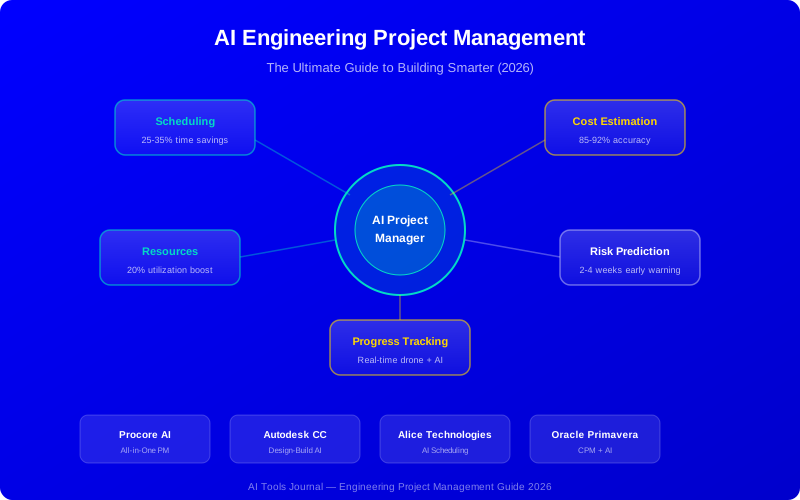
AI project management tools fall into five categories. Each solves a different piece of the project management puzzle.
Cost estimation: AI predicts costs using historical data and real-time market conditions.
Risk prediction: AI identifies potential problems weeks before they hit the critical path.
Resource allocation: AI matches the right crews, equipment, and materials to the right tasks.
Progress tracking: AI analyzes drone footage, sensor data, and photos to measure actual progress.
AI engineering project management spans five interconnected areas. The biggest gains come from using multiple categories together.
Top AI Engineering Project Management Platforms
1. Procore AI
Procore is the most widely used construction management platform, and its AI capabilities have expanded significantly in 2025-2026. It serves over 16,000 companies worldwide.
AI features:
Predictive schedule analysis that identifies tasks likely to slip
Automated daily log generation from site photos and field data
AI-powered quality inspection flagging from photo analysis
Subcontractor risk scoring based on past performance data
Automated RFI routing and response time prediction
Best for: General contractors managing multiple projects. Enterprise pricing starts at $35,000/year.
2. Autodesk Construction Cloud
Autodesk Construction Cloud integrates AI across the project lifecycle—from BIM design through construction through handover. Its biggest advantage is the tight connection between design models and project execution.
AI features:
Risk insights from BIM model analysis and construction data
AI clash detection that prioritizes high-impact design conflicts
Predictive cost modeling using regional and historical benchmarks
Automated progress tracking through 360-degree photo capture
Best for: Design-build firms and owners who use BIM extensively. Annual cost: $25,000-80,000.
3. Alice Technologies
Alice Technologies is the specialist in AI scheduling optimization. It generates thousands of possible construction schedules and picks the optimal one based on your constraints.
AI features:
Generative scheduling that explores millions of task sequences
What-if analysis for resource changes, weather delays, and scope modifications
Constraint-based optimization across labor, equipment, and space
Schedule recovery suggestions when projects fall behind
Best for: Complex projects with $50M+ budgets. Enterprise pricing.
4. Oracle Primavera with AI
Oracle Primavera P6 is the industry standard for large project scheduling. Oracle has added AI capabilities that predict delays, optimize resource leveling, and flag risk areas in complex CPM networks.
Best for: Infrastructure, energy, and mega-projects using CPM scheduling.
5. nPlan
nPlan uses machine learning trained on 600,000+ projects to predict actual durations for schedule activities. It gives you probability distributions—not single numbers—so you understand the range of likely outcomes.
Best for: Owners and contractors who want data-driven schedule risk assessment.
Platform Comparison
Platform
Best Category
Project Size
Starting Price
BIM Integration
Procore AI
All-in-one PM
$5M+
$35K/year
Via Autodesk
Autodesk CC
Design-Build
$10M+
$25K/year
Native
Alice Technologies
Scheduling
$50M+
Enterprise
Revit, Navisworks
Oracle Primavera
CPM Scheduling
$100M+
$80K/year
Via API
nPlan
Schedule Risk
$10M+
$40K/year
Via API
AI Scheduling Optimization
Scheduling is where AI delivers the fastest measurable results. Traditional scheduling relies on estimator experience. AI scheduling analyzes thousands of historical projects to predict actual durations and find optimal sequences.
AI scheduling tools process your work breakdown structure (WBS) and apply three layers of intelligence:
Duration prediction: AI predicts how long each activity will actually take—not just the estimate. It accounts for crew productivity, weather, site conditions, and historical accuracy.
Sequence optimization: AI tests thousands of task orderings to find sequences that reduce total duration. It considers resource constraints, spatial conflicts, and trade stacking.
Risk buffering: AI places time buffers where they matter most—on high-variance activities and convergence points—rather than blanket contingency.
Results: Firms using AI scheduling report 15-25% shorter project durations compared to experience-based scheduling alone.
AI Cost Estimation
Engineering cost estimation is part science, part art. AI makes it more science. Machine learning models trained on completed projects predict costs with 85-92% accuracy—compared to 60-75% for manual estimation on complex projects.
How AI Cost Estimation Works
Historical analysis: AI learns cost patterns from your completed projects and industry databases
BIM quantity extraction: AI automatically counts quantities from 3D models—no manual takeoff needed
Market pricing: AI incorporates current material and labor rates from market data feeds
Risk-adjusted budgets: AI calculates cost ranges with confidence intervals, not single-point estimates
Top tools: ProEst AI, Autodesk Takeoff, and CostOS calculate estimates in hours instead of weeks. ProEst customers report 40% faster estimate turnaround with 15% better accuracy.
AI Risk Prediction
Every project has risks. AI doesn't eliminate them—it finds them 2-4 weeks before they become problems.
What AI Risk Models Detect
Schedule risks: Activities likely to slip based on historical patterns and current progress
Cost risks: Budget line items trending over budget based on spending patterns
Safety risks: Conditions correlated with incident history (weather, crew fatigue, activity type)
Supply chain risks: Materials with volatile lead times or price instability
Contractual risks: Milestones at risk of triggering liquidated damages
How it works: Risk AI assigns probability scores and impact ratings to each identified risk. Project managers see a risk dashboard ranked by expected cost impact. This replaces the manual risk register that's updated monthly with a living risk model that updates daily.
AI Resource Allocation
Resource allocation is the most complex challenge in multi-project engineering firms. AI solves it by optimizing across all projects simultaneously.
AI Resource Optimization Capabilities
Cross-project scheduling: AI balances crew availability across 10+ simultaneous projects
Equipment utilization: AI predicts equipment needs and minimizes idle time and mobilization costs
Skills matching: AI assigns workers based on certifications, experience, and task requirements
Weather-responsive: AI automatically adjusts outdoor crew schedules based on weather forecasts
InEight and Procore lead in AI resource allocation. Firms report 15-20% improvement in equipment utilization and 10-15% reduction in idle labor hours.
AI Progress Tracking
Knowing where your project actually stands—not where you think it stands—is the foundation of effective management. AI makes progress tracking automatic and objective.
AI Progress Tracking Methods
Drone + AI: Drones capture sites weekly. AI compares photos to BIM models to calculate percent complete. OpenSpace and DroneDeploy lead this space.
IoT sensors: Concrete sensors, equipment trackers, and worker badges generate real-time activity data. AI aggregates it into progress dashboards.
Photo AI: Site photos from smartphones are analyzed by AI to detect safety violations, quality issues, and progress milestones. Procore and Autodesk both offer this.
AI progress tracking eliminates the 2-3 week lag in traditional reporting. Project managers see actual status daily instead of relying on weekly field reports.
AI delivers measurable improvements across all five project management categories. Risk detection and progress tracking show the largest gains.
Implementation Guide
Here's how to bring AI into your project management workflow:
Step 1: Audit Your Current Pain Points
Identify where projects lose the most time and money. Most firms find scheduling delays and cost overruns are the biggest problems. Start there.
Step 2: Choose Your Entry Point
Don't try to implement everything at once. Pick one category:
If projects are always late: Start with AI scheduling (Alice Technologies or nPlan)
If estimates are unreliable: Start with AI cost estimation (ProEst or Autodesk Takeoff)
If you need visibility: Start with AI progress tracking (OpenSpace or DroneDeploy)
If you manage many projects: Start with an all-in-one platform (Procore or Autodesk CC)
Step 3: Prepare Your Data
AI needs historical project data to deliver predictions. Gather:
Historical schedules with actual vs. planned durations
Cost reports from completed projects (at least 5-10 projects)
Risk logs showing what risks materialized and their impacts
Resource records showing crew productivity and equipment utilization
Step 4: Run a Pilot Project
Choose a mid-complexity project for your first AI deployment. Run AI alongside your traditional approach for one project. Compare the AI recommendations with your team's decisions. Track where AI was right and where it wasn't.
Step 5: Scale Based on Results
After your pilot, measure the actual impact on schedule, cost, and risk. Use those results to justify wider adoption. Most firms need 2-3 successful pilots before organization-wide rollout.
Integration with BIM and IoT
AI project management becomes dramatically more powerful when connected to BIM models and IoT sensor data.
BIM + AI Integration
AI extracts quantities automatically from BIM models for cost estimation
4D scheduling links AI-optimized schedules to 3D elements for visual planning
Clash detection feeds directly into AI risk models
As-built vs. designed comparisons drive automated progress tracking
IoT + AI Integration
Equipment sensors feed utilization data into AI resource optimization
Concrete maturity sensors provide real-time data for AI scheduling adjustments
Worker location data helps AI track actual labor distribution across zones
Environmental sensors (dust, noise, temperature) feed into AI safety models
AI project management is evolving rapidly. Watch for these trends in 2026-2027:
Autonomous scheduling: AI that automatically adjusts schedules in real-time as conditions change
Digital twin integration: AI models that simulate entire project lifecycles before construction starts
Generative design + AI PM: AI that designs and plans simultaneously for optimal buildability
Natural language interfaces: "What happens to the schedule if steel delivery is 2 weeks late?" answered instantly
The firms that adopt AI project management now will have a significant competitive advantage by 2028. The data advantage compounds—each project makes your AI models smarter.
Pricing ranges from $50-500 per user per month depending on the platform and features. Enterprise licenses for platforms like Procore and Autodesk typically run $20,000-100,000 annually. Most vendors offer tiered plans. Midsize firms usually spend $30,000-60,000 per year for a comprehensive AI project management stack.