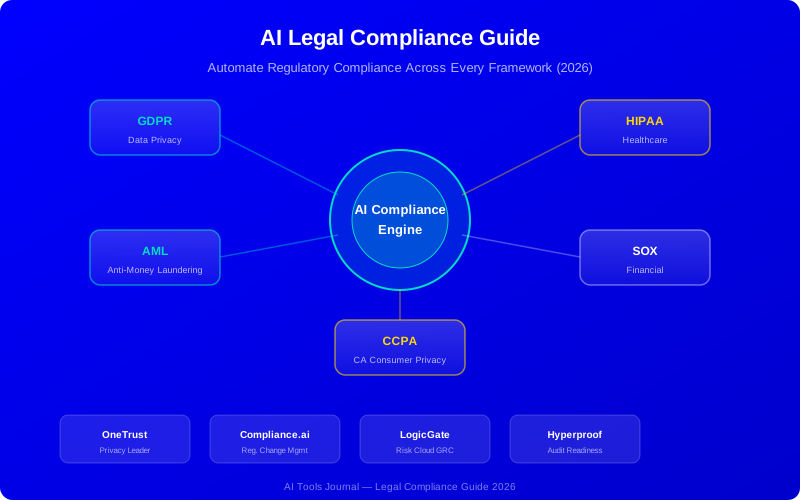
AI compliance tools cut regulatory review time by 60% and catch 40% more violations. This pillar guide covers GDPR, HIPAA, SOX, and more—with platform comparisons, implementation steps, and ROI analysis.
Start with regulatory change monitoring or audit trail management for the fastest ROI.
AI catches 30-50% more compliance gaps than manual audits across all regulatory frameworks.
Regulatory compliance is getting more complex every year. The average company must comply with over 200 regulatory requirements across multiple jurisdictions. Manual tracking and document review can't keep up. 73% of compliance professionals say they can't monitor all applicable regulations manually.
AI compliance tools are the answer. They monitor regulatory changes in real-time, automate policy mapping, and catch compliance gaps that human reviewers miss. This guide covers the complete AI compliance landscape for 2026.
If you're looking for an overview of AI compliance tools, our AI Compliance Tools Guide is a great starting point. This article goes deeper on implementation, platform comparisons, and regulatory-specific strategies.
The AI Compliance Landscape in 2026
The compliance technology (RegTech) market reached $12 billion in 2025 and is growing at 22% annually. AI is the driving force. Here's what's changed:
Real-time monitoring: AI tracks regulatory updates across 300+ global jurisdictions simultaneously
Automated gap analysis: AI compares new regulations against your existing policies automatically
Continuous auditing: AI runs compliance checks daily instead of quarterly or annually
Predictive enforcement: AI predicts which regulations will face increased enforcement activity
The shift from periodic manual audits to continuous AI monitoring is the most significant change in compliance management this decade.
Top AI Compliance Platforms
1. OneTrust
OneTrust is the market leader in AI-powered compliance, used by 14,000+ companies. It covers privacy (GDPR, CCPA), security (SOC 2), ethics, and ESG compliance in one platform.
AI capabilities:
Automated data discovery and classification across all systems
AI-driven data subject access request (DSAR) processing—90% automated
Regulatory intelligence that maps changes to your specific obligations
Cookie consent management with AI-powered scanner
Third-party risk assessment with AI vendor scoring
Best for: Enterprise companies managing privacy compliance across multiple jurisdictions. Pricing starts at $50,000/year for enterprise.
2. Compliance.ai
Compliance.ai specializes in regulatory change management. Its AI reads and interprets regulatory text, maps obligations to your policies, and generates action items for your compliance team.
AI capabilities:
Natural language processing that reads regulatory text like a compliance expert
Automated obligation extraction from complex regulatory documents
Impact analysis showing which business units are affected by each change
Compliance workflow automation with task assignment and tracking
Best for: Financial services, healthcare, and heavily regulated industries. Mid-market pricing.
3. LogicGate Risk Cloud
LogicGate offers a flexible GRC (Governance, Risk, Compliance) platform with AI that adapts to any regulatory framework. It's the most customizable option.
AI capabilities:
AI risk scoring that prioritizes compliance activities by impact
Automated evidence collection and audit preparation
Cross-framework mapping (e.g., SOC 2 controls that also satisfy ISO 27001)
Predictive analytics for compliance risk trends
Best for: Companies managing multiple regulatory frameworks simultaneously.
4. Hyperproof
Hyperproof focuses on continuous compliance monitoring with strong AI-powered evidence collection. It automates the most tedious part of compliance: gathering and organizing proof.
Best for: Companies preparing for SOC 2, ISO 27001, or HIPAA audits.
5. Securiti
Securiti takes a data-first approach, using AI to discover, classify, and protect sensitive data across all systems. It builds compliance from the data layer up.
Best for: Data-intensive organizations needing privacy compliance (GDPR, CCPA, LGPD).
Platform Comparison
Platform
Best For
Key Regulations
Starting Price
Deployment
OneTrust
Privacy & Ethics
GDPR, CCPA, ESG
$50K/year
Cloud
Compliance.ai
Reg. Change Mgmt
Financial, All
$30K/year
Cloud
LogicGate
Multi-Framework
All frameworks
$25K/year
Cloud
Hyperproof
Audit Readiness
SOC 2, ISO, HIPAA
$20K/year
Cloud
Securiti
Data Privacy
GDPR, CCPA, LGPD
$35K/year
Cloud/Hybrid
A single AI compliance platform can monitor and manage multiple regulatory frameworks simultaneously—eliminating siloed compliance programs.
AI for GDPR Compliance
GDPR remains the most impactful privacy regulation worldwide. AI makes GDPR compliance manageable instead of overwhelming. For a detailed walkthrough, see our guide on AI GDPR compliance automation.
Where AI Helps Most with GDPR
Data mapping: AI automatically discovers and classifies personal data across all systems—databases, cloud storage, email, and SaaS applications
Consent management: AI tracks consent records, expiration dates, and withdrawal requests across millions of data subjects
DSAR processing: AI automates data subject access requests—finding, compiling, and redacting data in hours instead of weeks
Breach detection: AI identifies potential data breaches and estimates impact for 72-hour notification requirements
Data retention: AI enforces retention schedules and automatically flags or deletes data past its lawful retention period
Cost impact: Companies using AI for GDPR compliance report 60-75% reduction in compliance labor costs. A mid-size company typically saves $200,000-500,000 annually compared to fully manual GDPR processes.
AI for HIPAA Compliance
Healthcare organizations face unique compliance challenges with protected health information (PHI). AI addresses the scale problem—millions of patient records, thousands of access points, and hundreds of business associates to monitor.
AI HIPAA Capabilities
PHI detection: AI scans all data repositories to find unprotected PHI that shouldn't be there
Access monitoring: AI analyzes EHR access patterns to detect unauthorized or suspicious access
Risk assessment: AI conducts continuous HIPAA risk assessments instead of annual point-in-time audits
Business associate management: AI tracks BAA compliance status and flags vendors with security gaps
Training compliance: AI monitors employee training completion and identifies knowledge gaps
AI for Financial Compliance (SOX, AML)
Financial compliance has the highest stakes—non-compliance means SEC enforcement, criminal charges, and massive fines. AI provides the continuous monitoring that financial regulations demand.
SOX Compliance
AI monitors internal controls continuously—not just during audit season
Automated evidence collection reduces audit prep from months to weeks
AI detects control deficiencies in real-time instead of discovering them during audits
Segregation of duties analysis runs continuously across all systems and roles
AML Compliance
AI transaction monitoring reduces false positives by 50-80% compared to rules-based systems
Customer risk scoring updates dynamically based on behavior changes
AI-powered sanctions screening processes thousands of transactions per second
Suspicious activity report (SAR) drafting is 70% automated with AI
Implementation Roadmap
Follow this phased approach to deploy AI compliance successfully:
Phase 1: Assessment (Weeks 1-4)
Inventory all applicable regulations and current compliance gaps
Audit existing compliance processes and identify the most time-consuming activities
Evaluate platforms based on your regulatory requirements and budget
Assemble a cross-functional implementation team (legal, IT, operations)
Phase 2: Foundation (Weeks 5-12)
Deploy the chosen platform and configure it for your primary regulatory framework
Migrate existing compliance documentation and policies into the system
Set up data integrations with key systems (HRIS, DMS, ticketing)
Train compliance team members on the AI platform (typically 8-16 hours)
Phase 3: Activation (Weeks 8-16)
Enable AI monitoring in shadow mode—it flags issues but doesn't auto-assign tasks
Validate AI-generated findings against known compliance status
Fine-tune alert thresholds and priority scoring based on shadow results
Transition to live mode with automated workflows
Phase 4: Expansion (Months 4-12)
Add regulatory frameworks one at a time (e.g., start with GDPR, then add SOX)
Integrate AI compliance with broader GRC platform
Implement continuous compliance dashboards for leadership
Establish regular model tuning sessions to improve accuracy
A phased rollout reduces risk and lets your team build confidence with AI compliance tools before full deployment.
ROI Analysis
AI compliance tools pay for themselves. Here's a typical ROI breakdown for a mid-size company (500-2,000 employees):
Cost Category
Manual Process
With AI
Annual Savings
Compliance staff time
$800K
$320K
$480K
External audit prep
$200K
$60K
$140K
Regulatory fines (avoided)
$150K avg
$20K avg
$130K
Legal counsel hours
$300K
$150K
$150K
Total
$1.45M
$550K
$900K
Against a platform cost of $50,000-100,000/year, the typical ROI is 9-18x the investment. The ROI is even higher if you factor in prevented data breaches and regulatory investigations.
Common Mistakes to Avoid
Trying to automate everything at once. Start with one regulatory framework and expand. Companies that try to launch across 5+ frameworks simultaneously have a 60% failure rate.
Ignoring data quality. AI compliance tools are only as good as the data they analyze. Clean up your existing compliance data before deployment.
Skipping the shadow period. Running AI alongside manual processes for 4-6 weeks catches edge cases and builds team trust. Don't skip this step.
Under-investing in training. Budget 10-15% of your implementation cost for team training. The technology fails when people don't use it correctly.
Choosing based on price alone. The cheapest platform often lacks regulatory depth. Match the tool to your specific regulatory requirements and industry.
No. AI handles the heavy lifting—monitoring regulatory changes, scanning documents, and flagging gaps—but human compliance officers make the judgment calls. AI reduces the manual work by 60-70% so compliance teams can focus on strategy, risk assessment, and stakeholder communication. Think of AI as a force multiplier, not a replacement.