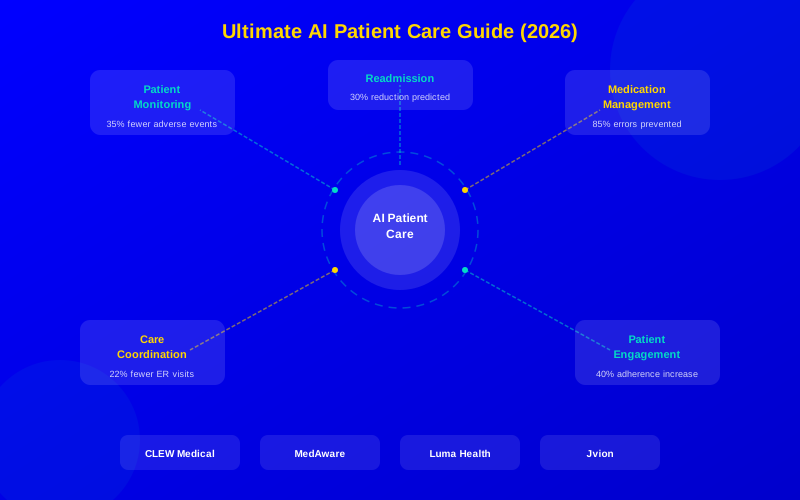
How AI is transforming patient care in 2026. This guide covers monitoring, medication management, care coordination, engagement tools, and readmission prediction.
AI patient monitoring systems reduce adverse events by 35% through early warning detection.
Medication management AI prevents 85% of drug interaction errors before they reach patients.
Care coordination platforms cut readmission rates by 20-30% at leading hospitals.
Patient engagement apps powered by AI improve treatment adherence by 40%.
The best AI patient care tools integrate with existing EHR systems like Epic and Cerner.
AI is saving lives in hospitals and clinics right now. From predicting cardiac arrests hours before they happen to catching dangerous drug interactions in real time, AI patient care tools have moved from experimental to essential in 2026.
This guide covers every major area where AI improves patient care. You'll learn about the leading tools, proven outcomes, and practical steps to bring AI into your practice or hospital system.
What This Guide Covers:
AI-powered patient monitoring and early warning systems
Medication management and drug interaction prevention
Care coordination platforms that reduce readmissions
Patient engagement and adherence tools
Readmission risk prediction models
Implementation strategies for healthcare organizations
The AI Patient Care Landscape in 2026
Healthcare AI investment hit $45 billion in 2025, and patient care applications lead the growth. According to the World Health Organization, AI-assisted clinical decisions now contribute to care in over 40% of hospital beds in developed countries.
What changed most in 2026 is integration. AI no longer sits in a separate system. It's embedded directly into EHR workflows, bedside monitors, and mobile care apps. Clinicians get AI insights without switching screens or learning new interfaces.
Key developments driving this shift:
EHR integration: Epic, Cerner, and Meditech now have built-in AI modules
Real-time processing: On-device AI analyzes vital signs with millisecond latency
Multimodal data: AI combines labs, vitals, imaging, and notes for holistic assessment
Regulatory clarity: The FDA's AI framework provides clear pathways for approval
"We've moved from AI as a research curiosity to AI as a clinical utility. The tools available in 2026 don't just analyze data—they actively prevent harm and improve outcomes in real time."
— Dr. Eric Topol, Founder of Scripps Research Translational Institute
AI-Powered Patient Monitoring Systems
AI monitoring systems watch patients around the clock and catch problems that human staff might miss during busy shifts. These tools analyze vital signs continuously and alert nurses before a patient deteriorates. For a detailed look at the best monitoring platforms, see our AI Patient Monitoring Systems guide.
How AI Monitoring Works
Traditional alarms fire based on simple thresholds—heart rate above 120, blood pressure below 90. These create alarm fatigue because 80-95% are false positives. AI monitoring changes this completely.
AI systems analyze patterns across multiple vital signs simultaneously. They detect subtle changes that indicate deterioration hours before a crisis. A slight heart rate increase combined with a small respiratory rate change and a minor temperature shift—individually normal, but together they signal sepsis.
Feature
Traditional Monitoring
AI-Powered Monitoring
Alert type
Single-threshold alarms
Multi-variable pattern detection
False alarm rate
80-95%
15-25%
Early warning
Minutes before event
6-12 hours before event
Learning
None
Adapts to each patient's baseline
Integration
Standalone displays
EHR, mobile alerts, nurse stations
AI patient care tools deliver measurable improvements across safety, adherence, and operational metrics.
Leading AI Monitoring Platforms
CLEW Medical uses predictive analytics to forecast respiratory failure, hemodynamic instability, and sepsis. It monitors ICU patients continuously and provides real-time risk scores to nurses and physicians.
Philips IntelliVue with AI combines bedside monitoring hardware with cloud-based AI. It analyzes waveform data from ECG, SpO2, and respiratory sensors to detect early deterioration patterns.
BioVitals by Biofourmis takes a different approach using wearable sensors. It monitors patients continuously—even after discharge—and alerts care teams to concerning trends. This extends care beyond hospital walls.
AI Medication Management Tools
Medication errors cause over 7,000 deaths annually in the US alone. AI medication management tools prevent these errors by checking every prescription against the patient's full medical record in real time. For more on AI in healthcare, explore our AI for Patient Care guide.
What AI Medication Tools Check
Drug-drug interactions: Flags dangerous combinations across all prescriptions
Allergy cross-references: Checks new prescriptions against documented allergies
Dosage verification: Adjusts for age, weight, kidney function, and liver function
Duplicate therapy: Catches when two drugs treat the same condition unnecessarily
Adherence prediction: Identifies patients likely to stop taking medications
Top AI Medication Management Tools
MedAware uses machine learning to detect prescription errors that standard drug databases miss. It learns from millions of prescriptions to spot unusual patterns—like a dose that's technically within range but unusual for a patient's specific condition.
DrFirst AI integrates directly into EHR prescribing workflows. It provides real-time clinical decision support with AI-enhanced drug information, pricing transparency, and prior authorization automation.
Arine focuses on medication optimization for complex patients. Its AI analyzes the full medication list and suggests simplification—reducing pill burden, switching to combination drugs, or eliminating unnecessary medications.
AI Care Coordination Platforms
Care coordination breakdowns cause 30% of readmissions. AI platforms keep every member of the care team—doctors, nurses, specialists, home health aides—informed and aligned.
How AI Improves Care Coordination
Challenge
Traditional Approach
AI Solution
Discharge planning
Manual checklist
Risk-stratified discharge protocols
Follow-up scheduling
Phone calls by staff
Automated scheduling with reminders
Care transitions
Faxed summaries
Real-time shared care plans
Social determinants
Rarely assessed
AI screens for SDOH risk factors
Team communication
Pagers and phone calls
Integrated messaging with AI triage
Leading AI Care Coordination Tools
Hinge Health leads in musculoskeletal care coordination. Its AI platform combines physical therapy exercises, wearable sensors, and health coaching to manage chronic pain patients remotely. Studies show a 69% reduction in surgical intent.
Lightbeam Health Solutions focuses on population health management. Its AI identifies high-risk patients across an entire network and automates care gap outreach. Health systems using Lightbeam report 22% fewer ER visits among managed populations.
CarePort by WellSky manages post-acute care transitions. When a patient is discharged, its AI matches them with the right post-acute provider (skilled nursing, home health, rehab) based on predicted needs and outcomes.
AI care coordination platforms connect every member of the care team through a centralized intelligence layer.
AI Patient Engagement Tools
Engaged patients have better outcomes. AI engagement tools make it easy for patients to understand their conditions, follow treatment plans, and communicate with their care team.
How AI Boosts Patient Engagement
Personalized health content: AI delivers education materials matched to each patient's reading level, language, and condition
Automated reminders: Smart reminders for medications, appointments, and lifestyle changes—timed by AI for best response rates
Symptom checkers: AI-powered triage helps patients decide when to call their doctor versus going to the ER
Two-way messaging: AI chatbots handle routine questions and escalate complex ones to human staff
Surveys and feedback: Automated satisfaction surveys with AI analysis of free-text responses
Leading Patient Engagement Platforms
Luma Health automates patient outreach across the entire journey. It handles appointment scheduling, waitlist management, referral tracking, and post-visit follow-ups. Its AI prioritizes outreach based on last-visit date, condition severity, and engagement history.
Klara provides a patient messaging platform that routes conversations with AI. Routine queries get instant AI responses. Clinical questions go to nurses. Scheduling requests go to front desk staff. This reduces phone calls by 50% while improving response times.
Twistle by Health Catalyst focuses on surgical patients. It sends personalized pre-op preparation instructions, post-op recovery guidance, and satisfaction surveys. Patients who use Twistle report 30% higher satisfaction scores.
AI Readmission Risk Prediction
Hospital readmissions cost the US healthcare system $26 billion annually. CMS penalizes hospitals with high readmission rates. AI prediction models identify which patients are most likely to return within 30 days—before they leave the hospital.
How AI Predicts Readmissions
AI readmission models analyze dozens of factors:
Clinical data: Diagnoses, procedures, lab values, vital signs at discharge
Medication complexity: Number of medications, new prescriptions, high-risk drugs
Social determinants: Insurance status, zip code, living situation, transportation access
Prior utilization: Previous ER visits, hospitalizations, missed appointments
Behavioral signals: Engagement with post-discharge instructions, medication refill patterns
Top AI Readmission Prediction Tools
Jvion goes beyond prediction to prescriptive analytics. It doesn't just say "this patient is high-risk"—it recommends specific interventions (home health visit, medication counseling, social work referral) based on what works for similar patients.
ClosedLoop.ai specializes in healthcare predictive inference. Its models achieve AUC scores above 0.80 for 30-day readmission prediction. It integrates with Epic, Cerner, and claims data to build comprehensive risk profiles.
KenSci (now part of LG) provides risk prediction across the care continuum. Its machine learning models predict not just readmissions but also ICU transfers, sepsis onset, and length of stay extensions.
Implementing AI in Patient Care: A Practical Guide
Bringing AI into clinical workflows requires careful planning. Here's a proven approach:
Step 1: Identify Your Biggest Pain Point
Start with one problem. Don't try to implement AI everywhere at once. The most common starting points are alarm fatigue (monitoring), medication errors (pharmacy), or readmission penalties (care coordination).
Step 2: Choose EHR-Integrated Tools
Tools that integrate with your existing EHR (Epic, Cerner, Meditech) get adopted faster. Standalone tools that require separate logins often get abandoned. Check the vendor's integration certifications.
Step 3: Run a Pilot
Start with one unit or department. Measure baseline metrics before implementation. Track the same metrics during the pilot. Common pilot durations are 90 days.
Step 4: Train Your Staff
AI tools are only as good as the people using them. Budget 2-4 hours of training per clinician. Focus on how to interpret AI alerts—not just how to click buttons.
Step 5: Measure and Expand
Compare pilot results to baseline. If the numbers improve, expand to additional units. Share success stories with staff to build buy-in across the organization.
"The hospitals seeing the best results from AI aren't the ones with the biggest budgets. They're the ones that start small, measure everything, and expand based on evidence."
— Dr. Atul Gawande, Surgeon and Public Health Researcher
Choosing the Right AI Patient Care Tools
Small Practices (1-10 Providers)
Luma Health: Patient engagement and scheduling
Klara: Patient messaging and triage
DrFirst: Medication management
Community Hospitals (50-200 Beds)
BioVitals by Biofourmis: Remote patient monitoring
Lightbeam: Population health management
MedAware: Prescription error prevention
Health Systems (500+ Beds)
CLEW Medical: ICU predictive analytics
Jvion: Readmission prediction and intervention
CarePort by WellSky: Post-acute care transitions
Now it's your turn. Identify the area where AI can have the most immediate impact in your practice. Start with patient engagement tools if you're new to healthcare AI—they're the easiest to implement and deliver visible results quickly.
Written by Amina Usman(Health & Legal Tech Writer)
Published: Feb 25, 2026
Tags
AI patient carehealthcare AIpatient monitoringmedication managementcare coordinationclinical AIreadmission predictionpatient engagement
Frequently Asked Questions
Many AI patient care tools have FDA clearance, especially those used for diagnostics and monitoring. The FDA has approved over 700 AI/ML-enabled medical devices as of 2026. However, AI always works alongside clinicians—it assists decisions but does not replace physician judgment. Always verify a tool's regulatory status before clinical use.