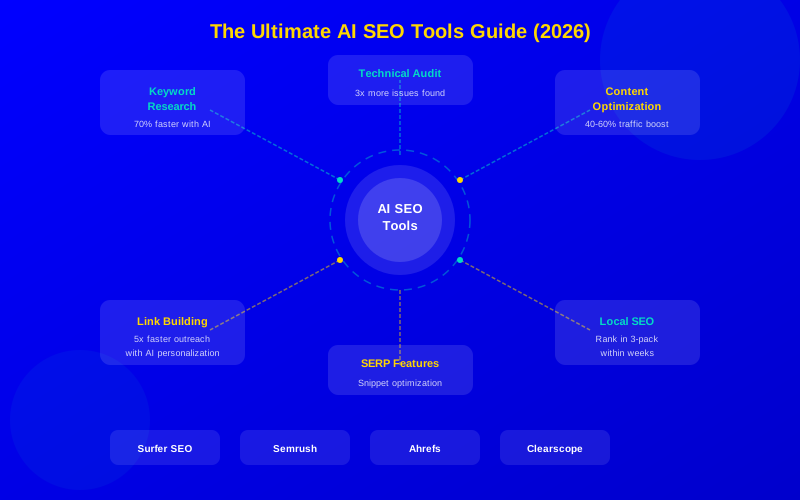
Master AI-powered SEO in 2026. This guide covers every major AI SEO tool, from keyword research to technical audits, link building, and local SEO optimization.
AI SEO tools reduce keyword research time by 70% and improve content ranking accuracy.
The top AI SEO platforms in 2026 are Surfer SEO, Semrush Copilot, Ahrefs AI, and Clearscope.
AI-powered technical SEO audits catch 3x more issues than manual reviews.
Content optimization tools boost organic traffic by 40-60% when used consistently.
AI link building tools identify high-quality prospects 5x faster than manual outreach.
Local SEO optimization with AI helps businesses rank in 3-pack results within weeks.
AI has transformed SEO from a guessing game into a data-driven science. In 2026, AI SEO tools don't just suggest keywords—they analyze search intent, optimize content in real time, audit technical issues automatically, and even predict ranking changes before they happen.
This guide covers every major AI SEO tool available in 2026. You'll learn which tools work best for each SEO task, how to build an AI-powered SEO workflow, and how to get measurable results fast.
What This Guide Covers:
Complete comparison of AI SEO tools by category
Keyword research and clustering with AI
AI-powered content optimization strategies
Technical SEO audit automation
AI link building and outreach tools
Local SEO optimization with AI
The AI SEO Landscape in 2026
The SEO industry has changed dramatically. Google's AI-powered search results, including AI Overviews and Search Generative Experience, mean that traditional keyword stuffing is dead. What works now is deep topical authority, semantic relevance, and user-first content—exactly what AI SEO tools help you build.
According to BrightEdge research, 68% of all online experiences still start with a search engine. And organic search drives 53% of all website traffic. AI SEO tools help you capture that traffic more efficiently than ever.
Key trends shaping AI SEO in 2026:
Search intent matching: AI tools now predict what searchers really want, not just what they typed
Entity-based SEO: Tools map relationships between topics, people, and brands for better rankings
Real-time optimization: Content editors score and adjust your writing as you type
Predictive analytics: AI forecasts ranking changes and traffic trends weeks ahead
"AI SEO tools have moved from suggesting keywords to understanding entire topic ecosystems. The best tools in 2026 help you build topical authority, not just rank for individual pages."
— Lily Ray, VP of SEO Strategy at Amsive
Complete AI SEO Tool Comparison
Choosing the right tool depends on your SEO goals, team size, and budget. Here's how every major AI SEO platform compares:
Semrush leads the AI SEO market with 34% share, followed by Ahrefs at 28% and Surfer SEO at 16%.
AI-Powered Keyword Research
Traditional keyword research meant hours of sorting spreadsheets. AI keyword tools now analyze search intent, group related keywords into clusters, and predict which terms will drive the most traffic. For a deep dive into keyword grouping strategies, see our AI Keyword Clustering Tools guide.
How AI Changes Keyword Research
AI keyword tools go beyond search volume and difficulty scores. They understand semantic relationships between keywords. This means they can tell you that "best running shoes" and "top sneakers for jogging" target the same search intent—even though the words are different.
Here's what AI keyword tools do that traditional tools can't:
Intent classification: Automatically label keywords as informational, commercial, transactional, or navigational
Topic clustering: Group hundreds of keywords into content-ready clusters
Gap analysis: Find keywords your competitors rank for that you don't
Trend prediction: Forecast rising keywords before they peak
Question mining: Extract real questions people ask about your topics
Best AI Tools for Keyword Research
Semrush Keyword Magic Tool remains the gold standard. Its AI analyzes 25 billion keywords and suggests clusters based on semantic similarity. The Copilot feature highlights the highest-opportunity keywords automatically.
Ahrefs Keywords Explorer added AI-powered difficulty predictions that account for your specific domain authority. It tells you not just how hard a keyword is but how hard it is for you.
Surfer Keyword Research focuses on content clusters. Give it one seed keyword, and it maps out an entire topic cluster with recommended articles, internal linking plans, and content briefs.
AI Content Optimization Tools
Content optimization is where AI SEO tools deliver the most visible results. These tools analyze the top-ranking pages for any keyword and give you a real-time score as you write. If you're already using AI tools for content optimization, these platforms take it to the next level.
Surfer SEO Content Editor
Surfer's content editor is the most popular AI writing assistant for SEO. It scores your content from 0-100 based on:
Word count compared to top-ranking pages
NLP-detected terms and phrases you should include
Heading structure and depth
Image density and alt text coverage
Internal and external link suggestions
Teams using Surfer report a 40-60% increase in organic traffic within 3-6 months of consistent use.
Clearscope Content Grading
Clearscope targets enterprise teams. Its AI builds a semantic model of each topic, then grades your content against it. The grading system is simple: aim for an A+ score, and you'll likely outrank competitors.
Clearscope also integrates with Google Docs and WordPress, so writers don't need to switch tools.
MarketMuse Content Strategy
MarketMuse takes a different approach. Instead of optimizing individual pages, it maps your entire site's topical authority. It identifies where you're strong, where you have gaps, and what content you need to build authority in a topic cluster.
"The shift from single-page optimization to topical authority mapping is the biggest change in 2026 SEO. Tools like MarketMuse and Surfer make this process manageable even for small teams."
— Cyrus Shepard, Founder of Zyppy
AI-Powered Technical SEO Audits
Technical SEO issues can tank your rankings even if your content is perfect. AI audit tools now crawl your site and identify issues that would take a human auditor days to find. For tips on how to improve your content alongside technical fixes, check out our AI keyword research tools guide.
What AI Technical SEO Tools Catch
Issue Category
Examples
AI Detection Speed
Crawlability
Broken links, orphan pages, redirect chains
Minutes (vs hours manually)
Indexability
Duplicate content, thin pages, noindex conflicts
Minutes
Page speed
Large images, render-blocking scripts, CLS issues
Real-time
Schema markup
Missing or invalid structured data
Seconds per page
Mobile usability
Touch targets, viewport issues, font sizes
Real-time
Core Web Vitals
LCP, INP, CLS thresholds
Real-time monitoring
Top AI Technical SEO Tools
Semrush Site Audit uses AI to prioritize issues by impact. It doesn't just list problems—it tells you which fixes will move the needle most. The tool suggests specific fixes for each issue. It crawls up to 100,000 pages per audit.
Ahrefs Site Audit combines crawl data with search traffic data. This means it prioritizes issues on pages that actually get traffic, not just any broken link on a forgotten page.
Screaming Frog with AI Integration remains the power user's choice. Its 2026 update includes AI-powered content analysis, automatic internal link suggestions, and JavaScript rendering analysis.
A modern AI-powered SEO workflow automates five key steps, from keyword research through continuous monitoring.
AI Link Building and Outreach
Link building remains one of the hardest parts of SEO. AI tools now handle the tedious parts—finding prospects, personalizing outreach emails, and tracking responses—so you can focus on building real relationships.
How AI Improves Link Building
Prospect discovery: AI scans millions of pages to find relevant, high-authority sites in your niche
Contact finding: Automatically finds editor and webmaster email addresses
Email personalization: Writes customized outreach emails based on the prospect's content
Follow-up automation: Sends timed follow-ups without sounding robotic
Success prediction: Scores prospects by likelihood of responding positively
Top AI Link Building Tools
Postaga uses AI to generate full outreach campaigns. Give it a URL or topic, and it finds link prospects, drafts personalized emails, and schedules follow-ups. It also analyzes why a prospect might link to you and tailors the pitch accordingly.
Respona combines link building with digital PR. Its AI finds journalist contacts, monitors for brand mentions, and identifies broken link opportunities across the web.
Pitchbox targets agencies managing link building at scale. Its AI prioritizes prospects by domain authority, relevance, and response probability.
AI for Local SEO Optimization
Local businesses need different SEO strategies. AI local SEO tools manage Google Business Profiles, monitor local rankings across zip codes, and generate location-specific content.
Key AI Local SEO Features
Feature
What It Does
Top Tool
Review management
AI responds to reviews, flags negative sentiment
BrightLocal
Local rank tracking
Tracks rankings by zip code and distance
Whitespark
Citation building
Submits NAP data to 100+ directories
Moz Local
GBP optimization
Suggests posts, photos, and category updates
BrightLocal
Local content
Generates location-specific landing pages
Rio SEO
Winning the Local 3-Pack
The Google Local 3-Pack appears in 93% of local searches. AI tools help you rank there by:
Optimizing your Google Business Profile with AI-suggested descriptions, categories, and attributes
Building consistent citations across directories automatically
Generating review responses that show engagement and build trust
Creating location pages optimized for each service area
Monitoring competitor activity in your local market
AI SERP Feature Optimization
Featured snippets, People Also Ask boxes, and AI Overviews now dominate search results. AI tools help you target these features specifically.
How to Win Featured Snippets with AI
AI tools analyze the structure of current featured snippets and reverse-engineer what Google wants. They then suggest content formats—paragraphs, lists, tables—that match the snippet type for each keyword.
Surfer SEO highlights which keywords have featured snippet opportunities and tells you exactly what format to use. Semrush Position Tracking monitors your snippet wins and losses daily.
Optimizing for Google AI Overviews
Google's AI Overviews pull from multiple sources to answer queries directly. AI SEO tools help you get cited by:
Structuring content with clear, concise answers
Using proper heading hierarchy and schema markup
Building E-E-A-T signals (Experience, Expertise, Authority, Trust)
Targeting question-based keywords
Building Your AI SEO Workflow
You don't need every tool. Build a workflow around your biggest needs:
Starter Stack (Under $150/month)
SE Ranking ($44/mo): Keyword research + rank tracking + site audit
Surfer SEO ($69/mo): Content optimization + topic clusters
Google Search Console (Free): Real performance data
Professional Stack ($300-500/month)
Semrush ($130/mo): All-in-one platform with AI Copilot
Surfer SEO ($119/mo): Advanced content editor with team features
Postaga ($84/mo): AI link building and outreach
Enterprise Stack ($800+/month)
Semrush Business ($500/mo): Full suite with API access
Time savings: Hours saved on research, writing, and auditing
Conversion rate: Are organic visitors converting?
Most teams see positive ROI within 3-4 months of consistent AI SEO tool usage. The key word is consistent—using tools sporadically won't move the needle.
Future of AI SEO: What's Coming Next
The SEO landscape will keep evolving. Here's what to watch:
Autonomous SEO agents: AI that runs keyword research, writes content, and builds links with minimal human input
Voice and visual search optimization: Tools that optimize for non-text search modalities
Real-time SERP adaptation: Content that automatically adjusts based on current rankings
Cross-platform SEO: Tools that optimize for Google, Bing, YouTube, TikTok, and AI assistants simultaneously
Now it's your turn. Start with one tool that addresses your biggest SEO challenge. If content is your weakness, try Surfer SEO. If you need a complete platform, go with Semrush. If backlinks are holding you back, pick Ahrefs. Test for free, measure results, and scale up from there.
AI SEO toolskeyword researchcontent optimizationtechnical SEOlink buildingAI marketingsearch engine optimizationSEO automation
Frequently Asked Questions
Yes. Many AI SEO tools offer plans starting at $29-49/month. A single well-optimized article can drive hundreds of monthly visitors. The ROI becomes positive within 2-3 months for most small businesses. Tools like Surfer SEO and SE Ranking offer affordable starter plans with AI features included.