Compare the best AI-powered SIEM platforms for 2026. Learn how machine learning transforms security information and event management with faster detection, fewer false positives, and automated response.
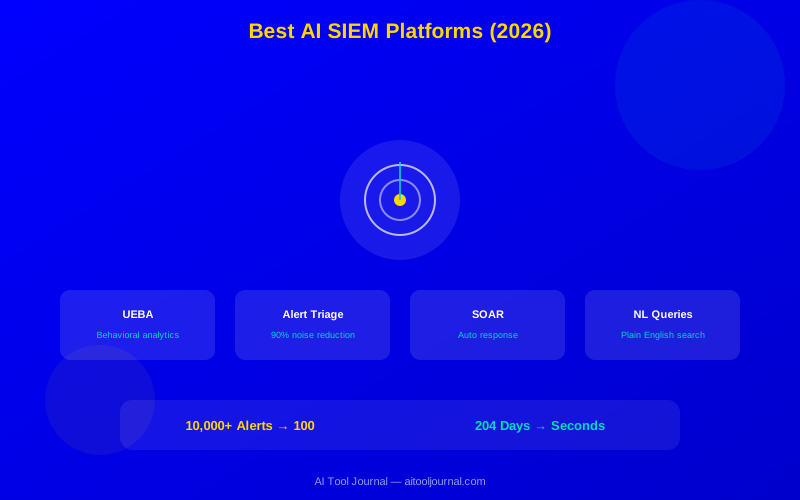
AI SIEM platforms reduce alert fatigue by 90%, filtering thousands of daily alerts down to actionable incidents.
Cloud-native SIEMs like Microsoft Sentinel and Google Chronicle eliminate hardware costs and scale automatically.
Modern SIEM platforms detect threats in seconds instead of the industry average of 204 days for breach discovery.
SOAR integration allows SIEMs to automatically respond to common threats without human intervention.
UEBA (User and Entity Behavior Analytics) catches insider threats that rule-based detection misses.
SIEM pricing ranges from free (Wazuh) to $50+ per GB/day (Splunk) depending on data volume and features.
Security teams drown in alerts. The average SOC receives over 10,000 alerts per day. Most are false positives. Analysts spend hours chasing noise while real threats slip through unnoticed. The result: the average breach goes undetected for 204 days.
AI-powered SIEM platforms fix this. They use machine learning to correlate events across your entire environment, separate real threats from noise, and automate responses to common attack patterns. Instead of reviewing thousands of alerts, analysts focus on the handful that actually matter.
This article compares the best AI SIEM platforms for 2026 and helps you choose the right one for your organization. For a broader view of AI in cybersecurity, our Complete AI Threat Detection Guide covers the full landscape including endpoint detection, network security, and threat intelligence.
What AI SIEM Does Differently
Traditional SIEMs rely on rules. You write correlation rules like "alert if five failed logins from the same IP within 10 minutes." These rules catch known attack patterns but miss anything new or creative.
AI SIEMs learn what normal looks like. They build behavioral baselines for every user, device, and application in your environment. When something deviates from normal—even in ways no one anticipated—the AI flags it. This catches zero-day attacks, insider threats, and lateral movement that rules-based systems miss entirely.
Key AI Capabilities
UEBA (User and Entity Behavior Analytics) — Detects anomalous behavior by comparing activity against learned baselines
Automated alert triage — ML models prioritize alerts by severity and confidence, reducing noise by 90%
Threat correlation — AI connects related events across different data sources to reconstruct full attack chains
Predictive detection — Identifies attack precursors before damage occurs
Natural language queries — Ask questions in plain English instead of writing complex query languages
AI SIEM reduces actionable alerts from 10,000+ to under 100 per day while improving detection accuracy
Top AI SIEM Platforms Compared
Microsoft Sentinel
Microsoft Sentinel is a cloud-native SIEM built on Azure. It ingests data from Microsoft 365, Azure, AWS, GCP, and hundreds of third-party sources. Its AI capabilities include fusion detection (correlating low-fidelity alerts into high-confidence incidents), UEBA, and built-in SOAR playbooks.
Best for: Organizations using Microsoft 365 and Azure. The integration is seamless—Entra ID, Defender, and Sentinel share intelligence automatically.
Pricing: $2.46/GB ingested. Free 5 GB/day. Commitment tiers reduce cost by up to 50% at 500+ GB/day.
Splunk Enterprise Security
Splunk is the most mature SIEM platform with the largest ecosystem. Its machine learning toolkit, adaptive thresholds, and risk-based alerting are industry-leading. Splunk acquired SOAR capabilities through Phantom and recently integrated AI assistants for natural language investigation.
Best for: Large enterprises with complex, multi-cloud environments that need maximum flexibility and customization.
Pricing: Workload-based pricing starting at $15/GB/day. Enterprise deployments typically cost $100,000-500,000+/year.
Google Chronicle (SecOps)
Google Chronicle stores security telemetry at Google scale with fixed-price storage. Its Gemini AI integration enables natural language threat hunting and automated investigation summaries. Chronicle normalizes data using Google's Unified Data Model, making cross-source correlation fast and consistent.
Best for: Organizations that need unlimited data retention without unpredictable storage costs.
Pricing: Fixed annual pricing (not per-GB). Custom quotes based on environment size.
Elastic Security (SIEM)
Elastic Security is built on the Elasticsearch platform, offering SIEM, endpoint detection, and cloud security in one solution. Its open-source foundation means no vendor lock-in. AI capabilities include anomaly detection, threat intelligence correlation, and the Elastic AI Assistant for natural language queries.
Best for: Organizations that want flexibility, self-hosting options, and no per-GB ingestion fees.
Pricing: Free self-managed tier. Elastic Cloud starts at $95/month for 120 GB storage.
Wazuh
Wazuh is a free, open-source SIEM and XDR platform. It provides log analysis, intrusion detection, vulnerability scanning, and compliance monitoring. While it lacks the advanced AI of commercial platforms, it is a solid starting point for organizations with limited budgets.
Best for: Budget-conscious organizations, startups, and teams that want full control over their security infrastructure.
Pricing: Free and open-source. Wazuh Cloud starts at $450/month.
Platform Comparison Table
Platform
Deployment
AI Features
SOAR Built-in
Starting Cost
Microsoft Sentinel
Cloud (Azure)
Fusion, UEBA, Copilot for Security
Yes
$2.46/GB
Splunk ES
Cloud / On-prem
ML Toolkit, adaptive thresholds, risk-based alerting
Yes (Phantom)
$15/GB/day
Google Chronicle
Cloud (GCP)
Gemini AI, UDM correlation, YARA-L detection
Yes (SOAR)
Custom pricing
Elastic Security
Cloud / Self-managed
Anomaly detection, AI Assistant, ML jobs
Partial
Free (self-managed)
Wazuh
Self-managed / Cloud
Rule-based + basic anomaly detection
Limited
Free (OSS)
IBM QRadar
Cloud / On-prem
Watson AI, offense chaining, UBA
Yes (SOAR)
Custom pricing
How to Choose the Right SIEM
Your SIEM choice depends on three factors: your existing tech stack, your data volume, and your budget.
Microsoft shops should default to Sentinel. The integration with Entra ID, Defender, and Microsoft 365 is unmatched. You get better detection with less configuration because the products share threat intelligence natively.
Multi-cloud or vendor-neutral organizations should evaluate Splunk or Google Chronicle. Splunk offers the most flexibility and largest partner ecosystem. Chronicle offers predictable pricing at scale.
Budget-constrained teams should start with Elastic Security or Wazuh. Both are free to self-manage and provide solid core SIEM functionality. Upgrade to commercial platforms as your security program matures.
Choose your SIEM based on your existing technology stack and budget priorities
SIEM Implementation Best Practices
Start with critical data sources — Ingest identity logs, firewall logs, and endpoint data first. Add more sources incrementally.
Tune before scaling — Spend the first 30 days tuning detection rules and suppressing known false positives. A noisy SIEM is worse than no SIEM.
Define use cases — Map detection rules to specific threats in the MITRE ATT&CK framework. This prevents gaps and eliminates redundant rules.
Automate tier-1 response — Use SOAR playbooks to handle common alerts (brute force, malware hash match, known-bad IP) automatically.
Plan retention and storage — Use hot/cold storage tiers. Keep 90 days hot for investigation, 1+ year cold for compliance.
Measure MTTD and MTTR — Track mean time to detect and mean time to respond. These are the metrics that determine whether your SIEM is working.
Getting Started
A SIEM is the command center of your security operations. Without one, threats go undetected for months. With AI-powered SIEM, your team detects and responds to threats in minutes instead of months.
Choose the platform that fits your stack, start with critical data sources, and expand coverage over time. The best SIEM is the one your team actually uses—so prioritize usability, integration with your existing tools, and manageable alert volume over feature checklists.
SIEMsecurity information managementAI threat detectionsecurity analyticsSplunkMicrosoft SentinelSOARlog managementincident responseSOC automation
Frequently Asked Questions
SIEM (Security Information and Event Management) collects and analyzes log data from across your entire IT environment—firewalls, servers, endpoints, cloud services, applications. It correlates events to detect threats, generates alerts for security teams, and provides compliance reporting. AI-powered SIEMs use machine learning to reduce false positives and detect sophisticated attacks that rule-based systems miss.