Explore top AI underwriting platforms that automate risk assessment, speed up policy decisions, and improve accuracy. Zesty.ai, Cape Analytics, Earnix, and more — features, pricing, and use cases.
AI underwriting reduces policy issuance time from 2 weeks to under 5 minutes for standard applications.
Zesty.ai analyzes 130+ property data points from satellite imagery, cutting manual inspections by 85%.
Cape Analytics processes aerial images of 100 million+ US properties to deliver instant risk scores for insurers.
Earnix's AI pricing engine optimizes premiums in real time, improving loss ratios by an average of 8-12% for clients.
Insurers using automated underwriting report 70% lower operational costs and 35% faster time-to-bind for new policies.
Insurance underwriting used to take weeks. An applicant submitted paperwork, a human underwriter reviewed it, maybe ordered an inspection, and eventually issued a decision. AI has compressed that timeline to minutes.
Modern AI underwriting platforms analyze satellite imagery, credit data, claims history, and hundreds of other signals to assess risk instantly. The result is faster policy issuance, more accurate pricing, and lower costs for both insurers and policyholders.
This guide covers the best AI underwriting tools in 2026, how they work, and what they mean for the insurance industry. For the broader insurtech landscape, see our Complete AI Insurtech Guide.
What AI Underwriting Actually Does
Traditional underwriting relies on manual data collection, human judgment, and standardized rating tables. AI replaces most of that with automated data gathering and predictive models.
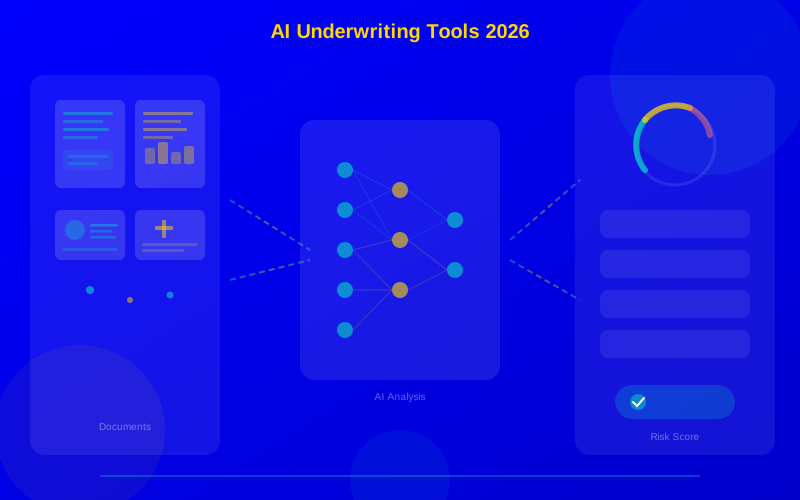
An AI underwriting system pulls data from dozens of sources automatically. Property data comes from satellite imagery, public records, and IoT sensors. Applicant data comes from credit bureaus, motor vehicle records, and medical databases (with consent). The AI weighs all these inputs simultaneously.
The output is a risk score, recommended premium, and an approve/decline/refer decision. Simple applications get instant approval. Complex ones are routed to human underwriters with an AI-prepared summary and risk analysis—saving hours of manual work.
AI underwriting processes 10x more data in a fraction of the time.
Top AI Underwriting Platforms
The market has several strong players, each with a different focus. Some specialize in property risk. Others handle life and health underwriting. Here are the leaders.
Zesty.ai
Zesty.ai is the most advanced property risk platform. It uses satellite imagery, weather data, and geospatial analytics to assess risk at the individual property level. The AI evaluates 130+ data points per property—roof condition, wildfire proximity, flood exposure, soil stability, and more.
Insurers use Zesty.ai for homeowners and commercial property underwriting. The platform's wildfire risk model is considered the most accurate in the industry. California insurers rely heavily on it after years of devastating wildfire losses. Zesty.ai processes risk assessments in seconds, replacing inspections that took weeks.
Cape Analytics
Cape Analytics specializes in aerial image analysis. Its AI has processed images of over 100 million US properties. The platform delivers instant property attributes—roof age, material, shape, solar panels, swimming pools, overhanging trees—without any manual inspection.
The data feeds directly into underwriting workflows. An underwriter can get a complete property profile in seconds. Cape Analytics reports that its data reduces loss ratios by 5-10% because underwriters price risk more accurately. The platform integrates with major policy administration systems.
Earnix
Earnix is the leader in AI-powered pricing and rating. Its platform uses machine learning to optimize insurance premiums in real time. Instead of updating rates annually, Earnix lets carriers adjust pricing dynamically based on changing risk factors.
The platform serves property, casualty, life, and health insurers. Earnix's AI considers competitive positioning, regulatory constraints, and profitability targets alongside risk data. Clients report 8-12% improvement in loss ratios. Over 100 insurers and banks use the platform globally.
Platform
Focus
Data Points
Key Benefit
Best For
Zesty.ai
Property risk
130+
Best wildfire model
Home and commercial
Cape Analytics
Aerial image analysis
100M+ properties
Instant property data
Property underwriting
Earnix
Pricing optimization
Dynamic models
8-12% loss ratio gain
All insurance lines
Verisk AI
Data analytics
Industry-wide
Broadest data library
Enterprise carriers
Bestow
Life underwriting
Health + behavior
No medical exam
Term life insurance
AI Property Underwriting in Detail
Property underwriting benefits the most from AI because physical risk is visible from above. Satellite and aerial images reveal roof damage, overgrown vegetation, building materials, and proximity to hazards—all without a site visit.
Zesty.ai combines imagery with climate modeling. Its wildfire risk scores consider not just current conditions but projected weather patterns, vegetation changes, and historical fire paths. This forward-looking approach helps insurers price policies for future risk, not just past data.
Cape Analytics focuses on speed. When a customer applies for home insurance, the carrier can pull a complete property profile in under a second. Roof age, material type, solar panels, detached structures—the AI catches details that even on-site inspectors sometimes miss.
AI Underwriting for Life Insurance
Life insurance underwriting has traditionally required blood tests, medical exams, and weeks of waiting. AI is eliminating that friction for many applicants.
Platforms like Bestow and Ladder use algorithmic underwriting for term life policies. The AI analyzes prescription history (from pharmacy databases), motor vehicle records, credit behavior, and application responses. For healthy applicants, the entire process takes under 10 minutes with no medical exam required.
This approach works for coverage up to $1.5 million. Higher amounts or applicants with complex health histories still go through enhanced underwriting. But even those cases benefit from AI—the system pre-gathers data so human underwriters start with a complete picture instead of a blank file.
AI Risk Scoring and Dynamic Pricing
Traditional insurance pricing uses broad categories—age brackets, credit tiers, geographic zones. AI enables individual-level pricing based on actual risk factors. This is more accurate and, for lower-risk customers, cheaper.
Earnix's platform calculates optimal prices considering risk, competition, regulation, and business goals. The AI runs thousands of pricing scenarios in seconds. If a competitor drops rates in a specific market, Earnix adjusts recommendations to stay competitive while maintaining profitability.
Usage-based insurance takes this further. Connected car data from devices like Progressive's Snapshot feeds into AI models that adjust auto premiums based on actual driving behavior. Safe drivers pay less. Hard brakers pay more. The pricing reflects real risk, not broad demographic averages.
AI underwriting cuts costs, speeds decisions, and improves pricing accuracy across the industry.
Regulatory Considerations
AI underwriting faces growing regulatory scrutiny. State insurance departments are developing frameworks to ensure algorithmic fairness. Key concerns include transparency, bias, and consumer protection.
Colorado passed the first comprehensive AI insurance regulation in 2023, requiring insurers to test AI models for unfair discrimination. Other states are following. The NAIC (National Association of Insurance Commissioners) has issued model guidelines that many states are adopting.
For insurers, this means documenting AI model decisions, conducting regular bias audits, and maintaining human oversight for consequential decisions. The good news is that well-designed AI often reduces bias compared to human underwriters, because the models apply rules consistently.
How Insurers Implement AI Underwriting
Adopting AI underwriting does not mean replacing everything overnight. Most carriers start with a specific line of business—personal auto or standard homeowners—and expand from there.
The typical implementation path starts with data integration. AI tools connect to existing policy administration systems through APIs. Zesty.ai, Cape Analytics, and Earnix all offer pre-built integrations with major platforms like Guidewire, Duck Creek, and Majesco.
Next comes model calibration. The AI trains on the carrier's historical underwriting data and claims outcomes. This ensures the model reflects the carrier's specific risk appetite and market position. Most deployments go live within 3-6 months.
Results come fast. Carriers typically see measurable improvements in processing speed within weeks. Accuracy gains build over time as the model processes more applications and learns from outcomes. For a look at how AI handles the other end of the policy lifecycle, see our guide on AI Claims Processing in Insurance.
The Future of AI Underwriting
The next evolution is continuous underwriting. Instead of assessing risk once at application time, AI will monitor risk continuously throughout the policy period. Connected devices, IoT sensors, and real-time data feeds make this possible.
Imagine a homeowners policy that adjusts dynamically. Install a smart water leak detector and your premium drops. Remove dead trees near your house and the wildfire risk score improves. The AI sees these changes through satellite updates and sensor data.
Embedded underwriting is growing too. AI will assess risk invisibly at the point of sale—when you buy a car, book a trip, or close on a house. The underwriting happens in milliseconds, behind the scenes. For the complete view of AI across the insurance industry, our Complete AI Insurtech Guide covers everything from underwriting to claims to customer experience.
AI underwriting uses machine learning to evaluate insurance applications and determine risk levels automatically. Instead of a human underwriter manually reviewing documents, inspecting properties, and calculating premiums, AI models analyze hundreds of data points—credit scores, claims history, property characteristics, satellite imagery, and more—to make faster and often more accurate risk decisions. The AI assigns risk scores, recommends pricing, and approves or declines applications.