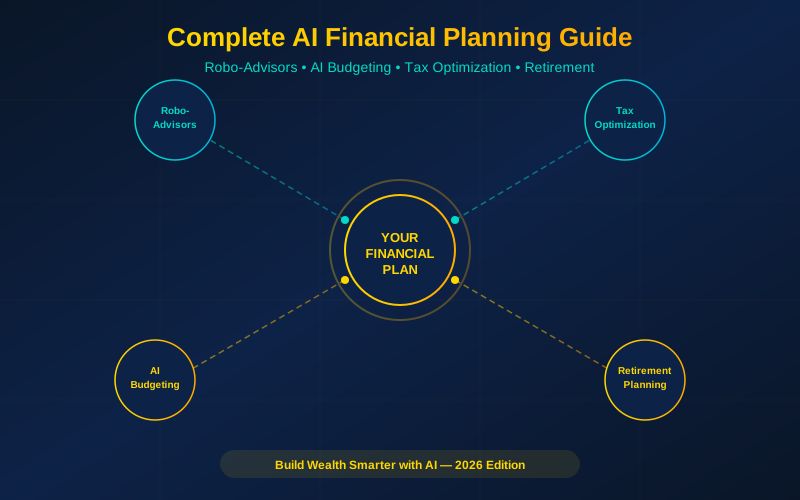
Discover the best AI financial planning tools for wealth management, budgeting, and retirement planning. Compare robo-advisors, pricing, features, and strategies to grow your money.
AI financial planning tools now manage over $1.5 trillion in assets, up from $460 billion in 2022.
Robo-advisors charge 0.25-0.50% annually versus 1-2% for traditional financial advisors.
AI-powered budgeting apps help users save an average of $2,400 more per year.
Tax-loss harvesting algorithms can add 1-2% to annual returns through automated optimization.
Most AI platforms offer free tiers or trials, making wealth management accessible to everyone.
AI retirement calculators now factor in inflation, healthcare costs, and Social Security projections for more accurate planning.
Managing money has never been easier. AI financial planning tools now handle portfolio management, budgeting, tax optimization, and retirement planning—tasks that once required expensive human advisors charging 1-2% of your assets every year.
In 2026, AI robo-advisors manage over $1.5 trillion in assets globally. They charge a fraction of what traditional advisors cost, and they work 24/7 without emotion or bias. Whether you have $500 or $5 million, there's an AI tool designed for your financial situation.
This guide covers the best AI financial planning platforms, how they work, what they cost, and how to choose the right combination for your goals. From automated investing to AI budgeting tools, you'll find everything you need to build a smarter financial plan.
What You'll Learn:
How AI financial planning tools work and why they're gaining popularity
The best robo-advisors and budgeting platforms compared
Pricing breakdowns for every budget level
How to build a complete AI-powered financial plan
Tax optimization strategies that AI handles automatically
What Is AI Financial Planning?
AI financial planning uses algorithms and machine learning to automate the core tasks of managing money. This includes investing, budgeting, saving, tax optimization, and retirement projections.
Traditional financial planning relies on human advisors who meet with you quarterly, review your portfolio, and suggest adjustments. That model works, but it's expensive and slow. AI platforms do the same work continuously—rebalancing portfolios, harvesting tax losses, and adjusting projections—with zero delay.
What AI Can Handle Today
Portfolio management — Builds and rebalances diversified portfolios based on your risk tolerance
Tax-loss harvesting — Sells losing positions to offset gains, then reinvests immediately
Automatic rebalancing — Keeps your asset allocation on target as markets move
Spending analysis — Categorizes transactions and identifies saving opportunities
Retirement projections — Models future income needs with inflation and healthcare adjustments
Goal tracking — Monitors progress toward buying a home, paying off debt, or building an emergency fund
AI vs Traditional Financial Advisors
Feature
Traditional Advisor
AI Financial Platform
Annual fee
1-2% of assets
0-0.50% of assets
Minimum investment
$25,000-$250,000
$0-$500
Rebalancing
Quarterly or on request
Daily or automatic on drift
Tax-loss harvesting
Annual or semi-annual
Daily automated scanning
Availability
Business hours, by appointment
24/7, always on
Emotional bias
Can be influenced by market fear
Algorithm-driven, emotion-free
Complex planning
Strong (estate, business, divorce)
Limited (improving with hybrid models)
Personalization
High (human relationship)
Moderate (questionnaire-based)
Annual cost comparison between traditional financial advisors (1% fee) and AI platforms (0.25% fee)
Best AI Robo-Advisors in 2026
Robo-advisors handle the investing side of financial planning. They build diversified portfolios, rebalance automatically, and optimize for taxes. Here are the platforms that lead the market.
1. Betterment
Betterment is the largest independent robo-advisor and the platform most people should start with. It combines low fees, no minimum balance, and smart automation into a polished experience.
Best for: Beginners and hands-off investors who want solid automation without complexity.
Feature
Details
Management fee
0.25% annually (Digital) | 0.65% (Premium with human advisor)
Goal-based investing with visual progress tracking
Cash management
High-yield cash account (4.00%+ APY)
Key strengths: Goal-based interface makes it easy to save for multiple targets simultaneously. Tax-coordinated portfolio feature optimizes asset placement across taxable and tax-advantaged accounts. The cash management account earns competitive interest.
Limitation: No direct indexing on smaller accounts. Premium tier is expensive relative to other robo-advisors.
2. Wealthfront
Wealthfront focuses on automation and tax efficiency. It pioneered automated tax-loss harvesting in the robo-advisor space and continues to lead in sophisticated tax optimization strategies.
Best for: Tax-conscious investors and high earners who want maximum tax optimization without manual effort.
Feature
Details
Management fee
0.25% annually
Account minimum
$500
Tax-loss harvesting
Yes, plus direct indexing on accounts $100K+
Account types
Individual, joint, IRA, Roth IRA, SEP IRA, 529
Key feature
Direct indexing (Tax-Level Optimization) for larger accounts
Cash management
High-yield cash account (4.25%+ APY)
Key strengths: Direct indexing on accounts above $100K can add 1-2% in after-tax returns. Clean, modern interface. Self-driving money feature automatically moves excess cash to investments. 529 college savings plans are available.
Limitation: $500 minimum means you can't start with nothing. No human advisor option at any tier.
3. Empower (formerly Personal Capital)
Empower combines AI-powered tools with access to human financial advisors. Its free dashboard is one of the best financial tracking tools available, even if you don't use their advisory service.
Best for: Investors with $100K+ who want AI automation plus human advisor access for complex decisions.
Feature
Details
Management fee
0.49-0.89% (tiered by balance)
Account minimum
$100,000 (advisory) | $0 (free dashboard)
Tax optimization
Tax-loss harvesting + tax location optimization
Account types
Individual, joint, IRA, Roth IRA, trust
Key feature
Free financial dashboard + retirement planner
Advisory
Dedicated human advisor + AI portfolio management
Key strengths: The free dashboard tracks all your accounts in one place—bank, investment, retirement, mortgage. The retirement planner runs Monte Carlo simulations against your actual portfolio. Hybrid AI + human model gives you the best of both worlds.
Limitation: Higher fees than pure robo-advisors. $100K minimum for advisory services.
4. M1 Finance
M1 Finance is unique. It combines a robo-advisor's automation with a self-directed investor's control. You choose your investments (or pick from expert portfolios), and M1 handles the automation.
Best for: DIY investors who want automation without giving up control over what they own.
Key strengths: Zero advisory fees for the basic tier. Fractional shares let you build a diversified portfolio with any amount. The "Pie" system lets you mix stocks, ETFs, and bonds in custom allocations. Smart rebalancing happens with every deposit.
Limitation: No automated tax-loss harvesting. Limited retirement planning tools compared to Betterment and Wealthfront.
5. SoFi Automated Investing
SoFi offers a completely free robo-advisor as part of its broader financial ecosystem. No management fees, no account minimums, and access to human advisors at no extra cost.
Best for: Cost-conscious beginners who want $0 fees and the convenience of an all-in-one financial platform.
Feature
Details
Management fee
$0 (completely free)
Account minimum
$1
Tax-loss harvesting
Not available
Account types
Individual, IRA, Roth IRA
Key feature
Free human advisor access + $0 management fee
Ecosystem
Banking, loans, insurance, crypto in one app
Key strengths: Free is hard to beat. Human advisors available to all members at no cost. Full financial ecosystem means banking, investing, loans, and insurance in one app.
Limitation: No tax-loss harvesting. Simpler portfolio options than Betterment or Wealthfront. Limited account types.
Robo-Advisor Comparison Table
Platform
Fee
Minimum
Tax-Loss Harvesting
Human Advisor
Best For
Betterment
0.25%
$0
Yes
Premium tier
Most people
Wealthfront
0.25%
$500
Yes + direct indexing
No
Tax optimization
Empower
0.49-0.89%
$100K
Yes
Yes (dedicated)
High-net-worth
M1 Finance
$0
$100
No
No
DIY investors
SoFi
$0
$1
No
Yes (free)
Beginners
Best AI Budgeting and Expense Tools
Investing is only half the equation. AI budgeting tools handle the other half—tracking spending, reducing waste, and making sure you have more money to invest in the first place.
Monarch Money
Monarch Money is the leading AI-powered budgeting app in 2026. It connects to all your accounts and uses machine learning to categorize transactions, track net worth, and forecast future cash flow.
Cost: $9.99/month or $99.99/year. 7-day free trial.
Key features: AI-powered transaction categorization (99%+ accuracy). Cash flow forecasting predicts your balance weeks ahead. Shared household finances with role-based access. Beautiful dashboard with net worth tracking across all accounts.
You Need A Budget (YNAB)
YNAB isn't purely AI-driven, but its method of giving every dollar a job—combined with smart automation—makes it the most effective budgeting system for people who struggle with overspending.
Cost: $14.99/month or $99/year. 34-day free trial.
Key features: Zero-based budgeting methodology. Bank syncing with smart categorization. Goal tracking with visual progress. New users save an average of $600 in their first two months and $6,000 in the first year, according to YNAB's data.
Copilot Money
Copilot is the most design-forward budgeting app available. It uses AI to proactively surface insights about your spending—like noticing a subscription price increased or your grocery spending is trending up.
Cost: $10.99/month or $69.99/year.
Key features: Beautiful iOS interface (Android coming 2026). AI spending insights surfaced proactively. Subscription tracking with price increase alerts. Investment tracking built in.
AI-Powered Retirement Planning
Retirement planning is where AI shines brightest. The calculations involve dozens of variables—inflation rates, Social Security projections, healthcare costs, tax brackets, life expectancy—that change constantly. AI models handle this complexity far better than a spreadsheet or annual advisor meeting.
Top AI Retirement Planning Tools
Empower Retirement Planner (free): The gold standard. Runs Monte Carlo simulations against your linked accounts. Shows probability of meeting your retirement goal. Adjusts for inflation, Social Security age, healthcare expenses, and planned major purchases.
Betterment Retirement Guide: Integrated into your investment account. Projects retirement income based on current savings rate. Recommends contribution increases needed to reach your target. Adjusts for IRA vs 401(k) tax implications.
NewRetirement Planner ($10-$50/month): The most detailed option. Over 150 input variables for precision planning. Includes estate planning, Roth conversion ladders, and Social Security optimization. Best for people within 10 years of retirement who need precise projections.
The five key components of a complete AI-powered financial plan
How to Build a Complete AI Financial Plan
You don't need one platform to handle everything. The best approach combines specialized tools into a cohesive system. Here's how to build yours step by step.
Step 1: Set Up Your Foundation (Day 1)
Open a free account with Empower to get the big picture. Connect all your bank accounts, credit cards, investment accounts, and loans. The dashboard shows your complete net worth and spending patterns in one view. This takes 15-30 minutes.
Step 2: Start Tracking Spending (Week 1)
Choose a budgeting tool that fits your style. Monarch Money is best for automated tracking. YNAB is best if you want to actively manage every dollar. Connect your accounts and let the AI categorize your spending for a week before making any changes.
After one week, review your spending categories. Most people find 10-20% of their spending goes to things they don't value—forgotten subscriptions, impulse purchases, and convenience fees.
Step 3: Automate Your Investing (Week 2)
Open an account with Betterment or Wealthfront. Set up automatic deposits from your paycheck. Even $100/month builds significant wealth over time thanks to compound growth. Turn on tax-loss harvesting if available.
Use Empower's free retirement planner to model your future. Input your target retirement age, expected Social Security benefits, and desired monthly income. The tool shows whether you're on track and what adjustments will get you there.
Step 5: Protect What You've Built (Month 2)
Use AI insurance comparison tools to make sure you have adequate coverage at the best price. Review life insurance, disability insurance, and umbrella liability coverage. These protect the financial plan you've worked hard to build. Check our AI insurance comparison tools guide for platform recommendations.
AI Tax Optimization Strategies
Tax optimization is one of the highest-value services AI financial tools provide. Every dollar saved in taxes is a dollar that compounds in your portfolio.
Tax-Loss Harvesting
AI scans your portfolio daily for opportunities to sell investments at a loss and immediately buy similar ones. The realized loss offsets capital gains taxes. This adds an estimated 1-2% to after-tax annual returns.
Wealthfront's data shows their algorithm harvests losses worth an average of 1.8% of portfolio value annually. On a $100,000 portfolio in the 32% tax bracket, that's roughly $576 in tax savings per year—every year.
Asset Location Optimization
Different investments have different tax profiles. AI platforms automatically place tax-inefficient assets (bonds, REITs) in tax-advantaged accounts (IRA, 401k) and tax-efficient assets (index funds, growth stocks) in taxable accounts. This is called tax-coordinated investing, and Betterment estimates it adds 0.48% in annual after-tax performance.
Direct Indexing
Instead of buying an S&P 500 index fund, AI purchases the individual stocks that make up the index. This lets it harvest losses on individual positions throughout the year while maintaining the same overall market exposure. Wealthfront offers this automatically for accounts above $100K.
Common Mistakes to Avoid
AI tools are powerful, but they work best when you avoid these common pitfalls.
Mistake 1: Checking Your Portfolio Too Often
AI handles your investments for a reason—so you don't have to. Checking your balance daily leads to emotional decisions. Markets fluctuate. That's normal. Let the algorithm handle rebalancing and check in quarterly at most.
Mistake 2: Using Too Many Tools
You don't need five budgeting apps and three robo-advisors. Pick one budgeting tool and one investment platform. Add complexity only when your financial situation demands it (usually above $250K in assets or when you have complex tax situations).
Mistake 3: Ignoring the Free Dashboard
Empower's free dashboard is incredibly valuable, yet many people skip it. Connecting all your accounts gives you a complete picture of your finances. You can't optimize what you can't see.
Mistake 4: Skipping Emergency Funds
Don't invest everything. Keep 3-6 months of expenses in a high-yield savings account or cash management account. Both Betterment and Wealthfront offer cash accounts earning 4%+ APY—far better than a traditional savings account.
The Future of AI Financial Planning
AI financial planning is still evolving fast. Here are the trends shaping the industry through 2027.
Conversational AI Finance
Platforms are adding natural language interfaces. Instead of navigating menus, you'll ask "Am I on track for retirement?" or "How much can I spend on vacation without hurting my savings goal?" and get instant, personalized answers based on your actual financial data.
Predictive Planning
AI models will predict life events—job changes, home purchases, medical expenses—based on patterns and proactively adjust your financial plan. Your platform might suggest increasing insurance coverage before a predicted life event or boosting savings when it detects a spending decrease.
Embedded Finance AI
Financial planning won't live in a separate app. AI-powered financial insights will be embedded in every platform you use—your banking app, your payroll system, even your shopping experience. The tools will know your financial picture and guide decisions in real time.
Conclusion
AI financial planning tools have democratized wealth management. Services that once required $250K minimums and 1-2% annual fees are now available to anyone with a smartphone and $1.
For most people, the winning combination is simple: Betterment or Wealthfront for automated investing, Monarch Money or YNAB for budgeting, and Empower's free dashboard for the complete picture. Total cost: under $250/year for a financial system that rivals what millionaires had access to a decade ago.
Start today. Open one account, connect your finances, and let AI start optimizing. The earlier you begin, the more compound growth works in your favor. Your future self will thank you.
AI financial planningwealth management toolsrobo-advisorfinancial planning softwareBettermentWealthfrontAI budgetingretirement planningautomated investing
Frequently Asked Questions
Yes. Major AI financial platforms like Betterment, Wealthfront, and Empower use bank-level encryption (256-bit AES) and are SEC-registered investment advisors. Your funds are held at SIPC-insured custodians, protecting up to $500,000 in securities. Always verify that any platform is SEC-registered before investing.