Compare AI-powered insurance quote tools that shop auto, home, life, and health rates across dozens of providers. Policygenius, The Zebra, Gabi, and more — features, savings, and how AI finds the best deal.
AI comparison tools save the average household $742 per year by scanning quotes from 40+ insurance carriers instantly.
Policygenius leads the market with the broadest coverage types and a 96% customer satisfaction rating.
The Zebra compares auto and home quotes in under 2 minutes using AI-driven form pre-fill and risk profiling.
AI-powered tools detect coverage gaps in existing policies, preventing an average of $12,000 in uninsured losses.
Gabi monitors existing policies continuously and alerts users when a better rate becomes available, saving an average of $825 per year.
Shopping for insurance used to mean calling five agents, repeating the same information, and waiting days for paper quotes. Those days are over. AI-powered comparison tools now scan dozens of carriers in seconds and find the best rate for your exact situation.
Whether you need auto, home, life, or health coverage, these platforms do the heavy lifting. You enter your details once, and AI handles the rest. The savings are real—most users save $500 to $1,000 per year just by comparing.
This guide covers the best AI insurance comparison tools in 2026. We break down features, pricing, and which tool fits your needs. For the full insurtech landscape, check our Complete AI Financial Planning Guide.
How AI Insurance Comparison Works
Traditional comparison sites just listed quotes. AI-powered tools go much further. They analyze your risk profile, predict which carriers will offer the best rates, and even spot coverage gaps you did not know existed.
Here is what happens behind the scenes. You fill out a short form with your details. The AI sends your profile to 40 or more carriers at once. Machine learning models then rank the results based on price, coverage quality, and carrier reliability.
The best tools also monitor your existing policies. If a better rate appears mid-cycle, you get an alert. This kind of continuous optimization was impossible before AI.
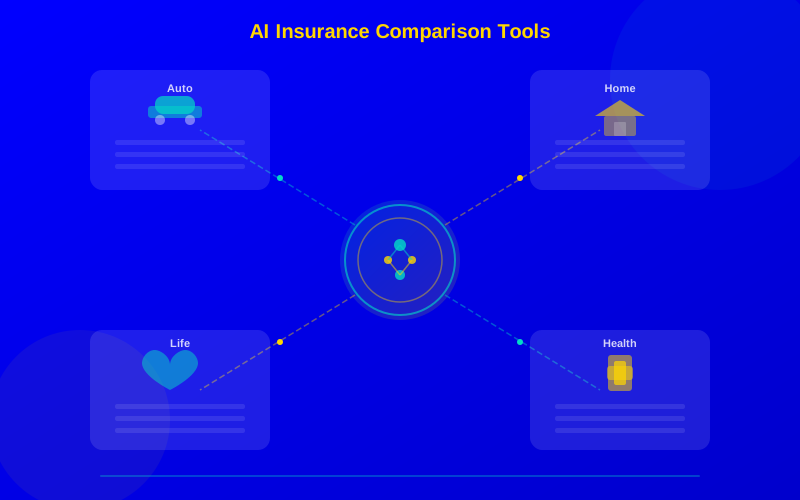
AI comparison tools scan dozens of carriers and rank results by price and coverage fit.
Top AI Insurance Comparison Tools
Not all comparison platforms are equal. Some focus on auto only. Others cover every insurance type. Here are the best options for 2026.
Policygenius
Policygenius is the most comprehensive comparison tool available. It covers auto, home, life, disability, renters, and pet insurance. AI matches your profile to the best carriers from a panel of over 30 providers.
The platform stands out for its licensed advisor support. After AI generates quotes, a human advisor reviews your coverage to catch gaps. This hybrid approach delivers both speed and accuracy. Policygenius reports a 96% satisfaction rate among users.
The Zebra
The Zebra is the fastest tool for auto and home insurance. Enter your details and AI returns quotes from 100+ carriers in under two minutes. The platform uses smart form pre-fill—it pulls public data to skip redundant questions.
The Zebra also offers a real-time rate comparison dashboard. You see exactly how each carrier stacks up on price, deductibles, and coverage limits. Users save an average of $670 per year on auto insurance alone.
Gabi (now Experian Insurance)
Gabi takes a different approach. Instead of starting fresh, it connects to your existing insurance accounts and scans for savings. AI compares your current policies against alternatives from 40+ carriers and alerts you when a better rate exists.
This passive monitoring model works well for people who forget to shop at renewal. Gabi saves the average user $825 per year. Since its acquisition by Experian, the platform now integrates credit data for even more precise rate matching.
Tool
Insurance Types
Carriers
Avg. Savings
Best For
Policygenius
Auto, Home, Life, Disability, Renters, Pet
30+
$742/yr
All-in-one comparison
The Zebra
Auto, Home
100+
$670/yr
Fast auto quotes
Gabi
Auto, Home, Renters
40+
$825/yr
Passive monitoring
Insurify
Auto, Home, Life
200+
$585/yr
Widest carrier network
Jerry
Auto, Home
50+
$887/yr
Full policy switch
AI for Auto Insurance Comparison
Auto insurance is where AI comparison tools shine brightest. Rates vary wildly between carriers—sometimes by 300% for identical coverage. AI eliminates that guesswork.
Modern tools pre-fill your driving record from public databases. They factor in your vehicle, mileage, credit score, and even parking location. The AI then predicts which carriers will offer the lowest rates for your specific risk profile.
The Zebra and Jerry are particularly strong for auto. Jerry goes a step further by handling the entire switch—canceling your old policy and enrolling the new one. Users report average savings of $887 per year. For those also exploring how AI handles the next step after buying coverage, see our guide on AI Claims Processing in Insurance.
AI for Home Insurance Comparison
Home insurance comparison is more complex than auto. AI must evaluate property data—square footage, roof age, proximity to fire stations, flood zone status—alongside your personal profile.
Policygenius handles home insurance comparison best. Its AI pulls property data from public records and satellite imagery. This means less form-filling for you and more accurate quotes. The platform also bundles home and auto for additional discounts.
Kin Insurance uses AI-powered aerial imagery to assess roof condition and property risk without sending an inspector. This speeds up the quote process from days to minutes. Homeowners in disaster-prone areas often find the best rates through AI tools that understand localized risk.
AI for Life and Health Insurance
Life insurance comparison has traditionally been slow—medical exams, weeks of underwriting. AI is changing that. Platforms like Policygenius and Bestow use predictive health models to offer instant quotes for term life coverage up to $1.5 million.
The AI analyzes your health data, prescription history (with permission), and lifestyle factors. Many applicants now skip the medical exam entirely. Algorithmic underwriting approves policies in under 10 minutes for healthy applicants.
For health insurance, Stride Health leads the market. Its AI recommends plans from the ACA marketplace based on your doctors, medications, and expected usage. The tool calculates total out-of-pocket cost, not just premiums—because a cheap premium with a $8,000 deductible is not actually cheap.
AI comparison tools deliver the largest savings on auto and health insurance.
How AI Detects Coverage Gaps
Finding a cheap rate is only half the job. AI comparison tools also spot dangerous gaps in your coverage. This feature alone can save you thousands in unexpected expenses.
The AI reviews your existing policies and flags areas where you are exposed. Common gaps include insufficient liability limits, missing umbrella coverage, and outdated home valuations. Policygenius reports that 43% of homeowners are underinsured by an average of $12,000.
Some tools cross-reference your assets against your coverage. If you bought a new car or renovated your kitchen, AI makes sure your policy reflects the updated value. This kind of proactive protection was previously only available from expensive human advisors.
AI-Optimized Bundling and Discounts
Insurance carriers offer bundling discounts—combine auto and home, or add life to the package—but the math gets complicated fast. AI tools calculate every possible bundle combination and show you the true total cost.
Sometimes the cheapest individual policies from different carriers beat a single carrier's bundle. AI figures that out instantly. Policygenius and Insurify both optimize for total household cost, not just individual policy price.
Beyond bundling, AI identifies discounts you may have missed. Smart home devices, defensive driving courses, good credit, professional memberships—carriers offer hundreds of discounts. AI matches your profile to every eligible one. For deeper financial optimization beyond insurance, see our Complete AI Financial Planning Guide.
Privacy and Data Security
Sharing personal data with comparison tools raises fair questions. The best platforms use bank-level 256-bit encryption and comply with SOC 2 security standards. Your data is transmitted securely and stored with strict access controls.
Policygenius and The Zebra only use soft credit pulls, which do not affect your credit score. They also share your data only with carriers you choose. Read privacy policies carefully—some lesser-known tools sell your data to third-party lead generators, which leads to spam calls.
Stick with established platforms that clearly state their data practices. If a tool is free but vague about how it makes money, your data may be the product.
Tips for Getting the Best Results
AI comparison tools work better when you give them accurate information. Underestimating your mileage or forgetting a speeding ticket leads to quotes that do not hold up at binding.
Run comparisons annually — Rates shift every renewal cycle. Set a calendar reminder.
Use multiple tools — No single platform has every carrier. Run Policygenius and The Zebra for the broadest view.
Compare total cost, not just premium — Factor in deductibles, coverage limits, and out-of-pocket maximums.
Report life changes — Marriage, a new home, or a teen driver changes your risk profile significantly.
Check carrier ratings — A cheap policy from an unstable carrier is not a bargain. Look for AM Best ratings of A or higher.
The Future of AI Insurance Shopping
The next wave of AI insurance comparison tools will use real-time data feeds. Connected car data, smart home sensors, and wearable health devices will feed continuous risk profiles to carriers. This means dynamic pricing—your rate adjusts monthly based on actual behavior.
Embedded insurance is growing too. AI will offer coverage at the point of purchase—buying a car, booking a trip, or closing on a house. The comparison happens invisibly in the background. Companies like AI claims processors are already making post-purchase insurance just as seamless.
For now, the tools above represent the best way to save on insurance in 2026. Spend 10 minutes comparing quotes and you could save $700 or more this year. The AI does the work—you just pick the best option.
Written by Amina Usman(Health & Legal Tech Writer)
AI insurance comparison tools collect your information once—age, location, driving record, property details—and send it to dozens of carriers simultaneously. Machine learning models match your risk profile against each carrier's pricing algorithms to predict which companies offer the lowest premiums for your situation. The AI also factors in bundling discounts, loyalty credits, and coverage gaps you might not know about.