Best AI XDR Platforms in 2026: Extended Detection & Response
Compare the top AI-powered XDR platforms that unify endpoint, network, cloud, and email security. Features, pricing, and deployment strategies for enterprise teams.
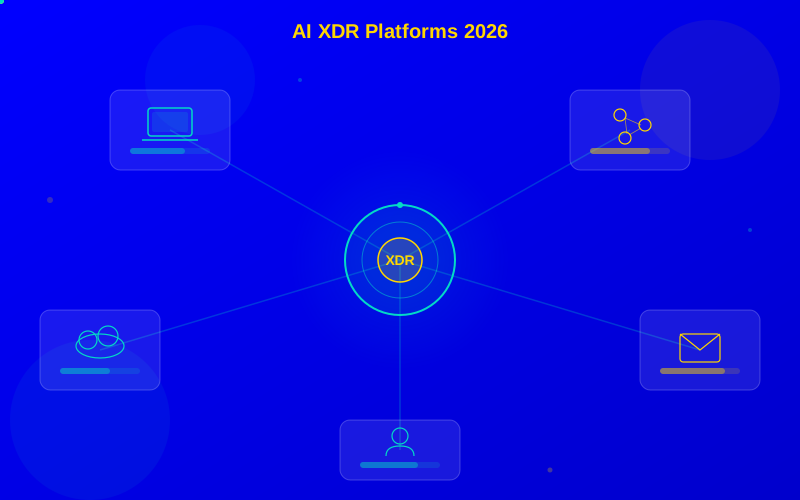
XDR unifies endpoint, network, cloud, and email security into a single platform with cross-source correlation.
The XDR market is projected to grow from $1.7 billion in 2024 to $8.8 billion by 2028.
AI-powered XDR reduces alert fatigue by 90%, correlating thousands of alerts into a handful of actionable incidents.
CrowdStrike, Palo Alto Cortex XDR, and Microsoft Sentinel lead the market with distinct deployment models.
Organizations using XDR detect breaches 50% faster than those using separate point solutions.
Security teams are drowning in alerts. The average SOC receives over 10,000 alerts per day from endpoint tools, firewalls, cloud security, email filters, and identity systems. Investigating each one separately is impossible. That is the problem XDR solves.
XDR (Extended Detection and Response) pulls telemetry from across your entire security stack into one AI-powered platform. Instead of checking five dashboards to piece together an attack, your team sees one correlated incident with the full attack story—from initial phishing email to lateral movement to data exfiltration.
This guide covers the best AI XDR platforms in 2026 and how to choose the right one. For related endpoint coverage, see our AI EDR tools guide. For the big picture, start with the Complete AI Threat Detection Guide.
What Is XDR and Why Does It Matter?
Traditional security creates silos. Your EDR monitors endpoints. Your firewall watches network traffic. Your CASB protects cloud apps. Your email security filters phishing. Each tool generates its own alerts with its own severity scores and its own investigation interface.
Attackers exploit these gaps. A sophisticated attack might start as a phishing email (detected by email security as "low severity"), then install a tool on an endpoint (detected by EDR as "medium severity"), then move laterally through the network (detected by the firewall as "anomalous traffic"). Each alert looks minor on its own. Together, they are a major breach in progress.
XDR connects these dots automatically. AI correlates signals across all sources and presents one high-confidence incident with the complete attack chain. Teams respond to real threats instead of chasing thousands of disconnected alerts.
XDR ingests data from five security sources and uses AI to reduce 10,000 daily alerts to a handful of real incidents
Top AI XDR Platforms Compared
Platform
Best For
Data Sources
Pricing Model
Key Strength
CrowdStrike Falcon XDR
Native EDR extension
Endpoint, cloud, identity, network
Per endpoint
Threat Graph + OverWatch hunting
Palo Alto Cortex XDR
Network-first organizations
Endpoint, network, cloud, identity
Per endpoint
Firewall + endpoint correlation
Microsoft Sentinel + Defender XDR
Microsoft ecosystems
All Microsoft + 300+ integrations
Per GB ingested
Copilot for Security AI
SentinelOne Singularity XDR
Autonomous response
Endpoint, cloud, identity
Per endpoint
On-device AI + rollback
Trend Micro Vision One
Mid-market value
Endpoint, email, network, cloud
Per user
Broad native coverage
CrowdStrike Falcon XDR
CrowdStrike extends its market-leading EDR into full XDR by ingesting data from third-party network, email, and cloud tools. The Threat Graph database—processing 2+ trillion events per week—provides the AI backbone for cross-domain correlation.
Falcon OverWatch adds 24/7 managed threat hunting. Human experts proactively search for threats across your environment, combining their expertise with AI automation. This hybrid approach is powerful for organizations that don't have a large internal security team.
Palo Alto Cortex XDR
Cortex XDR from Palo Alto Networks has a unique advantage: deep integration with Palo Alto firewalls and Prisma Cloud. If you already run Palo Alto network security, Cortex XDR correlates endpoint detections with firewall logs automatically. This network-native integration provides visibility that other XDR platforms can only achieve through third-party integrations.
Microsoft Sentinel + Defender XDR
Microsoft's approach combines Sentinel (cloud-native SIEM) with Defender XDR (unified security platform). The result is both a data lake for custom analytics and an AI-powered XDR for automated detection and response. Copilot for Security adds natural language investigation—ask "Show me all incidents affecting the finance department this week" and get instant answers.
For organizations already invested in Microsoft 365 and Azure, this combination offers the best value. The challenge is consumption pricing—data-heavy environments can face high costs.
Open XDR vs Native XDR
There are two approaches to XDR, and the right choice depends on your existing security stack.
Native XDR
Native XDR platforms (CrowdStrike, Palo Alto, SentinelOne) provide all data sources from their own product suite. The advantage is tight integration—everything works together out of the box. The disadvantage is vendor lock-in.
Open XDR
Open XDR platforms (Stellar Cyber, Hunters, ReliaQuest) integrate with your existing security tools regardless of vendor. They ingest data from your current EDR, firewall, email security, and cloud tools. The advantage is flexibility. The disadvantage is that integrations vary in depth.
Most enterprises are moving toward native XDR from their primary security vendor, supplemented by SIEM for data sources that XDR does not cover natively.
How to Deploy XDR
Step 1: Start with Your Strongest Data Source
If you already have CrowdStrike EDR, start with CrowdStrike XDR. If you run Palo Alto firewalls, Cortex XDR is the natural choice. Extend from your strongest existing data source rather than ripping and replacing everything.
Step 2: Connect Additional Data Sources
Add email, cloud, identity, and network data to your XDR platform. Each new source improves correlation accuracy. Most platforms provide pre-built integrations for popular tools. Full data integration typically takes 2-4 weeks.
Step 3: Tune Detection and Response
Run in detection-only mode for 14-30 days. Review incidents, tune false positive filters, and customize response playbooks. Then gradually enable automated response for high-confidence incidents.
Trend Vision One offers the lowest XDR entry point; Microsoft Sentinel costs depend on data ingestion volume
Choosing Your XDR Platform
If you run CrowdStrike EDR already, Falcon XDR is the natural upgrade. If Palo Alto firewalls are your foundation, Cortex XDR gives you the best network-to-endpoint correlation. Microsoft shops should evaluate Sentinel + Defender XDR for its native ecosystem integration and Copilot AI.
The key is consolidation. Every disconnected security tool creates blind spots that attackers exploit. XDR closes those gaps by giving your team one unified view of every threat across your entire environment. Start with your strongest data source and expand from there.
XDR (Extended Detection and Response) is a security platform that collects and correlates data from endpoints, networks, cloud workloads, email, and identity systems. Instead of investigating alerts from five separate tools, security teams see one unified view. AI correlates signals across all sources to detect complex attacks that no single tool would catch on its own.