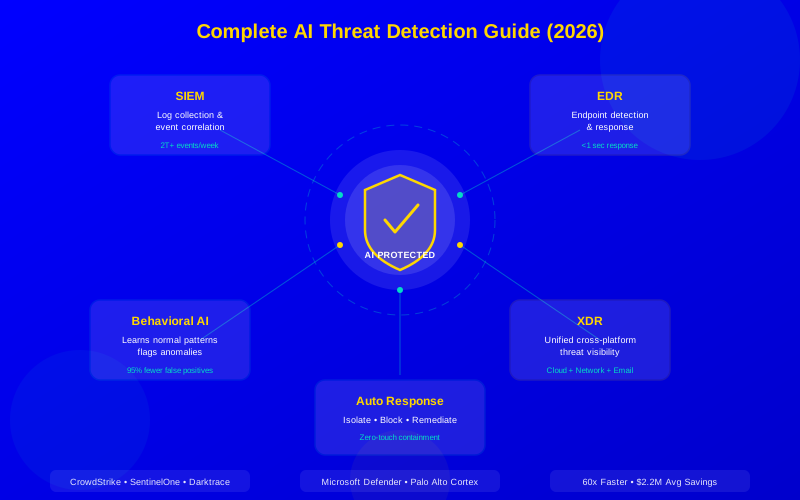
Discover how AI threat detection platforms protect your business from cyberattacks. Compare the best AI-powered SIEM, EDR, and XDR tools, pricing, features, and implementation strategies.
AI threat detection catches attacks 60x faster than manual investigation by analyzing billions of events in real time.
Modern platforms combine SIEM, EDR, and XDR capabilities into unified security dashboards.
CrowdStrike, SentinelOne, and Darktrace lead the market with distinct strengths for different business sizes.
Implementation costs range from $5 per endpoint per month for small teams to enterprise contracts above $100,000 annually.
AI reduces false positives by up to 95%, freeing security analysts to focus on real threats.
Most platforms now offer autonomous response—isolating compromised devices within seconds without human input.
Cyberattacks are faster, smarter, and more frequent than ever. In 2025, the average data breach cost businesses $4.88 million. Attackers now use AI themselves to craft phishing emails, discover vulnerabilities, and move through networks undetected.
Traditional security tools can't keep up. They rely on known attack signatures and simple rules. They miss zero-day exploits, insider threats, and sophisticated attacks that evolve in real time.
That's where AI threat detection comes in. These platforms use machine learning, behavioral analytics, and automation to find and stop attacks before they cause damage. They analyze billions of events per second, spot anomalies that humans would miss, and respond to threats in milliseconds.
This guide covers everything you need to know about AI-powered threat detection in 2026. You'll learn how these platforms work, which tools lead the market, what they cost, and how to choose the right one for your organization.
What You'll Learn:
How AI threat detection works and why it matters
The top AI threat detection platforms compared
Pricing breakdowns for every business size
Implementation steps and timelines
How to measure ROI on your security investment
What Is AI Threat Detection?
AI threat detection uses machine learning models to identify cyber threats in real time. Unlike traditional tools that match traffic against databases of known attacks, AI systems learn what "normal" looks like on your network. When something deviates from that baseline, they flag it instantly.
Think of it this way. Traditional antivirus is like a bouncer with a list of banned faces. AI threat detection is like a bouncer who knows how everyone usually behaves—and notices when someone acts suspicious, even if they're not on any list.
Core Capabilities
Modern AI threat detection platforms handle several critical functions:
Behavioral analysis — Learns user and device behavior patterns, then flags anomalies
Real-time correlation — Connects events across endpoints, networks, cloud apps, and email
Threat intelligence — Pulls from global threat feeds to identify known indicators of compromise
Predictive analysis — Identifies attack patterns before they fully execute
Traditional vs AI-Powered Detection
Feature
Traditional Detection
AI-Powered Detection
Detection method
Signature matching
Behavioral analysis + signatures
Zero-day threats
Missed until signature is created
Caught by anomaly detection
False positive rate
High (thousands daily)
Low (reduced by up to 95%)
Response speed
Hours to days (manual)
Seconds (automated)
Scalability
Limited by analyst headcount
Scales with compute power
Insider threats
Rarely detected
Detected via behavioral baselines
Cost at scale
Linear (more data = more analysts)
Sublinear (AI handles volume)
How AI Threat Detection Works
AI threat detection platforms follow a four-stage pipeline. Each stage builds on the last to turn raw data into actionable security intelligence.
Stage 1: Data Collection
The platform ingests data from every corner of your environment. This includes endpoint telemetry, network traffic, cloud audit logs, email headers, authentication events, and DNS queries. The best platforms process terabytes of data daily without slowing down.
CrowdStrike's Falcon platform, for example, processes over 2 trillion events per week across its customer base. This massive data pool helps its AI models identify threats that would be invisible in smaller datasets.
Stage 2: Behavioral Modeling
Machine learning algorithms build a baseline of normal behavior for every user, device, and application on your network. The model tracks patterns like login times, data access volumes, application usage, and network connections.
This baseline typically takes 7-14 days to establish. During this learning period, the platform observes without taking action. After that, it can spot deviations with high accuracy.
Stage 3: Anomaly Detection and Correlation
When behavior deviates from the baseline, the AI assigns a risk score. A single anomaly might score low—maybe a user logged in at an unusual hour. But the system correlates events across the environment. That same user also accessed a file server they never use, then started a large data transfer. Together, these events create a high-confidence alert.
This correlation is what separates AI tools from traditional SIEM systems. Traditional SIEMs generate thousands of uncorrelated alerts. AI-powered EDR and SIEM platforms connect the dots and present a complete attack story.
Stage 4: Automated Response
Once a threat is confirmed, the platform takes action without waiting for a human. Common automated responses include isolating an endpoint from the network, killing malicious processes, blocking IP addresses, disabling user accounts, and triggering incident response playbooks.
SentinelOne's Singularity platform calls this "autonomous response." It can detect, contain, and remediate threats in under one second on the endpoint itself—no cloud roundtrip required.
How AI threat detection platforms process data from collection to automated response
Best AI Threat Detection Platforms in 2026
The cybersecurity market has dozens of AI-powered tools. Here are the platforms that consistently lead in detection accuracy, response speed, and value.
1. CrowdStrike Falcon
CrowdStrike built its reputation on cloud-native endpoint protection. Its Falcon platform uses AI models trained on trillions of security events to detect threats with industry-leading accuracy.
Best for: Mid-market to enterprise organizations that want a proven, cloud-native platform with strong threat intelligence.
Feature
Details
Core capability
Cloud-native EDR/XDR with AI threat scoring
Detection approach
Behavioral AI + indicators of attack (IOA)
Deployment
Lightweight agent (25MB), cloud console
Response time
Sub-second detection, minutes for full correlation
Key strengths: Lightweight agent has minimal system impact. The Threat Graph database correlates events across CrowdStrike's entire customer base, improving detection for everyone. Strong managed detection service (Falcon Complete) for teams without in-house SOC staff.
Limitation: Full platform costs add up. Log management (Falcon LogScale) and identity protection are separate modules with extra costs.
2. SentinelOne Singularity
SentinelOne pioneered autonomous endpoint protection. Its Singularity platform can detect, respond to, and roll back attacks without cloud connectivity—everything happens on the device itself.
Best for: Organizations that need fully autonomous response or have devices that go offline regularly (manufacturing, field operations, remote sites).
Feature
Details
Core capability
Autonomous EDR/XDR with on-device AI
Detection approach
Static AI + behavioral AI, on-device models
Deployment
Agent with local AI engine, cloud or on-prem console
Key strengths: The Storyline feature automatically reconstructs the full attack narrative—showing every process, file, and network connection involved. One-click rollback can undo ransomware encryption and restore affected files. Purple AI assistant lets analysts ask questions in plain English.
Limitation: The on-device AI engine uses more system resources than CrowdStrike's lightweight agent.
3. Darktrace
Darktrace takes a different approach. Instead of relying on threat intelligence feeds, it uses unsupervised machine learning to understand your unique digital environment. It detects threats by finding patterns that don't fit—without needing to know what the threat looks like first.
Best for: Organizations facing sophisticated, novel attacks (financial services, government, critical infrastructure) where threats may not match any known patterns.
Feature
Details
Core capability
Self-learning AI for network and cloud security
Detection approach
Unsupervised ML, no signatures or rules needed
Deployment
Network appliance or virtual sensor, SaaS console
Response time
Real-time detection, Antigena autonomous response
Unique feature
Self-learning AI builds unique model per customer
Pricing
Starts ~$30,000/year for small deployments | Enterprise: $100K+
Key strengths: Excels at catching insider threats and novel attacks. The Cyber AI Analyst feature automatically investigates alerts and produces human-readable reports. No rules to write or signatures to maintain.
Limitation: Premium pricing puts it out of reach for many small businesses. The unsupervised learning approach means it needs a clean environment during training.
4. Microsoft Defender XDR
Microsoft's security platform has evolved from basic antivirus into a full AI-powered XDR suite. For organizations already using Microsoft 365 and Azure, Defender XDR offers deep integration that third-party tools can't match.
Best for: Microsoft-heavy environments where deep integration with Azure AD, Office 365, and Intune creates unique security advantages.
Feature
Details
Core capability
Unified XDR across endpoints, identity, email, cloud
Detection approach
AI correlation across Microsoft security graph
Deployment
Built into Windows, agents for Mac/Linux, cloud console
Response time
Automated investigation and remediation
Unique feature
Copilot for Security AI assistant
Pricing
Included in M365 E5 (~$57/user/mo) | Standalone Defender P2: ~$5/user/mo
Key strengths: Best value for Microsoft shops—Defender for Endpoint P1 is included in M365 E3. Copilot for Security lets analysts investigate threats using natural language. Deep integration means identity, email, and endpoint data correlate automatically.
Limitation: Less effective outside Microsoft ecosystems. Linux and Mac coverage exists but isn't as deep as Windows protection.
5. Palo Alto Cortex XDR
Palo Alto Networks created the XDR category and its Cortex platform remains one of the most comprehensive options. It integrates endpoint, network, cloud, and third-party data into a single detection engine.
Best for: Large enterprises with complex, multi-vendor security environments needing a platform that unifies everything.
Feature
Details
Core capability
Full XDR with network, endpoint, and cloud coverage
Detection approach
AI analytics + behavioral threat protection
Deployment
Agent-based + network sensors, cloud console
Response time
Automated investigation reduces triage by 8x
Unique feature
Ingests third-party firewall and security data
Pricing
Cortex XDR Pro: ~$12/endpoint/mo | Full XSIAM: custom enterprise pricing
Key strengths: Cortex XSIAM (their next-gen SOC platform) integrates SIEM, SOAR, ASM, and XDR into one platform. Reduces investigation time by 8x with AI-powered root cause analysis. Handles third-party data natively.
Limitation: Enterprise pricing can be aggressive. Best used alongside other Palo Alto products (firewalls, Prisma Cloud) for maximum integration.
AI Threat Detection Platform Comparison
Here's how the top five platforms stack up across the features that matter most. Use this comparison to narrow your shortlist based on your specific needs.
Capability
CrowdStrike
SentinelOne
Darktrace
Microsoft
Palo Alto
EDR
★★★★★
★★★★★
★★★☆☆
★★★★☆
★★★★★
XDR
★★★★☆
★★★★☆
★★★★☆
★★★★★
★★★★★
SIEM
★★★★☆
★★★☆☆
★★☆☆☆
★★★★★
★★★★★
Autonomous response
★★★★☆
★★★★★
★★★★☆
★★★☆☆
★★★★☆
Network security
★★★☆☆
★★★☆☆
★★★★★
★★★☆☆
★★★★★
Small business value
★★★★★
★★★★☆
★★☆☆☆
★★★★★
★★☆☆☆
AI assistant
Charlotte AI
Purple AI
Cyber AI Analyst
Copilot
Cortex XSIAM
Pricing comparison across entry and enterprise tiers for top AI threat detection platforms (2026)
How to Choose the Right AI Threat Detection Platform
The best platform depends on your environment, team size, and security maturity. Here's a decision framework to guide your selection.
Choose by Company Size
Small businesses (under 100 endpoints): Start with CrowdStrike Falcon Go or Microsoft Defender for Business. Both offer strong AI-powered protection at under $10 per device per month. If you use Microsoft 365, Defender is the easiest choice—it's already built in.
Mid-market (100-1,000 endpoints): CrowdStrike Falcon Pro or SentinelOne Singularity Control give you full EDR capabilities with automated response. For stronger network visibility, consider adding Darktrace at this stage.
Enterprise (1,000+ endpoints): Evaluate CrowdStrike Falcon Complete, SentinelOne Singularity Complete, or Palo Alto Cortex XSIAM. At this scale, you need full XDR, SIEM integration, and managed detection services. Run proof-of-concept trials with your top two choices.
Choose by Environment
Microsoft-heavy: Microsoft Defender XDR. Deep integration with Azure AD, Exchange, and Intune creates unique detection advantages.
Multi-cloud: Palo Alto Cortex XDR or CrowdStrike. Both handle AWS, Azure, and GCP workloads natively.
OT/Industrial: Darktrace excels at monitoring industrial control systems and operational technology networks with its unsupervised AI approach.
Remote/Offline devices: SentinelOne's on-device AI works without cloud connectivity, making it ideal for field operations and air-gapped environments.
Implementation Guide: Deploying AI Threat Detection
Deploying an AI threat detection platform involves more than installing agents. Here's a step-by-step process that security teams follow for successful rollouts.
Phase 1: Assessment (Week 1-2)
Map your current security stack and identify gaps. Count your endpoints, cloud workloads, and network segments. Document your log sources and data volumes. This assessment shapes your platform choice and licensing requirements.
Talk to your SOC team (or whoever handles security alerts today). Ask them what eats most of their time. The answer is usually alert triage and false positive investigation—exactly what AI eliminates.
Phase 2: Pilot Deployment (Week 2-4)
Deploy the platform to a representative subset of your environment—typically 50-100 endpoints across different roles and departments. Run in monitor-only mode for the first week so the AI learns your baselines without blocking anything.
During the pilot, evaluate detection quality, management console usability, and integration with your existing tools. Most vendors offer 15-30 day free trials for this purpose.
Phase 3: Tuning and Expansion (Week 4-8)
Review pilot results. Tune detection rules to reduce any remaining false positives. Build response playbooks that match your incident response procedures. Then roll out to additional endpoint groups in waves.
Enable automated response features gradually. Start with low-risk actions like alerting and file quarantine. Move to network isolation and process termination once you trust the platform's judgment.
Phase 4: Full Deployment and Optimization (Week 8-12)
Deploy across all endpoints and integrate remaining log sources. Build custom dashboards for different stakeholders (SOC analysts, IT managers, executives). Set up scheduled reports showing detection metrics, response times, and threat trends.
Run a tabletop exercise to test your new capabilities against realistic attack scenarios. This validates that the platform and your team work together effectively.
Real-World AI Threat Detection Use Cases
AI threat detection isn't just theory. Here are common scenarios where these platforms deliver measurable results.
Ransomware Prevention
AI platforms detect ransomware behavior patterns—rapid file encryption, shadow copy deletion, and lateral movement—before the attack completes. SentinelOne customers report catching and rolling back ransomware attacks in under 10 seconds, with zero data loss.
A sales manager starts downloading customer databases at 2 AM. A developer copies source code to a personal cloud storage account. An IT admin creates unauthorized backdoor accounts. AI behavioral analytics flags all of these by comparing current actions against established patterns.
Supply Chain Attack Detection
When a trusted vendor's software update contains malicious code (like the SolarWinds attack), traditional tools trust it because it comes from a legitimate source. AI platforms detect the unusual behavior that follows—unexpected network connections, unusual process execution, and data exfiltration attempts—regardless of who signed the code.
Cloud Security Monitoring
Cloud environments generate enormous volumes of logs and events. AI platforms analyze API calls, configuration changes, and access patterns across AWS, Azure, and GCP to catch misconfigurations, unauthorized access, and resource hijacking (cryptomining). Check out our guide on AI cloud security tools for cloud-focused platforms.
Cost and ROI of AI Threat Detection
Security investments need business justification. Here's how to think about the cost and return of AI threat detection platforms.
Total Cost Breakdown
Cost Component
Small Business
Mid-Market
Enterprise
Platform licensing
$3,000-$12,000/yr
$30,000-$120,000/yr
$100,000-$500,000+/yr
Implementation
Included or $2,000
$5,000-$15,000
$20,000-$75,000
Staff training
Self-service/free
$2,000-$5,000
$10,000-$25,000
Ongoing management
Part-time IT staff
1 security analyst
SOC team (3-8 analysts)
Estimated total (Year 1)
$5,000-$15,000
$40,000-$145,000
$150,000-$700,000+
Calculating ROI
The math is straightforward. The average data breach costs $4.88 million (IBM, 2025). Organizations using AI-driven security tools save an average of $2.22 million per breach compared to those without AI.
Beyond breach prevention, AI threat detection delivers ROI through:
Analyst efficiency — Automated triage saves 4-8 hours per analyst per day
Reduced dwell time — AI cuts attacker dwell time from 200+ days to under 24 hours
Insurance premiums — Many cyber insurers offer lower premiums for AI-protected organizations
Common Challenges and How to Solve Them
AI threat detection isn't plug-and-play. Here are the challenges teams face and how to address them.
Challenge 1: Alert Fatigue During Initial Deployment
Even AI platforms generate noise during the learning phase. The fix: run in monitor-only mode for 2 weeks, then incrementally enable enforcement. Tune out known-benign behaviors using allowlists. Most platforms reduce false positives to under 5% after proper tuning.
Challenge 2: Integration With Existing Tools
Your SIEM, ticketing system, and firewall all need to talk to the new platform. Choose vendors with pre-built integrations for your stack. CrowdStrike and Palo Alto have the broadest integration ecosystems. API-first platforms like SentinelOne make custom integrations straightforward.
Challenge 3: Security Skills Gap
Not every team has SOC analysts who know how to use advanced threat detection. AI assistants like CrowdStrike Charlotte AI, SentinelOne Purple AI, and Microsoft Copilot for Security bridge this gap. They let junior staff investigate threats using plain English queries instead of complex query languages.
Challenge 4: Data Privacy and Sovereignty
Cloud security platforms process your telemetry data in the vendor's cloud. For regulated industries, verify that the vendor's data centers meet your compliance requirements. CrowdStrike and SentinelOne both offer regional data residency options. For maximum control, SentinelOne supports on-premises deployment of the management console.
The Future of AI Threat Detection
AI threat detection is advancing rapidly. Here are the trends shaping the industry through 2027 and beyond.
Generative AI for Security Operations
Every major vendor now offers an AI assistant that lets analysts interact with security data using natural language. In 2026, these assistants handle investigation, reporting, and even playbook creation. By 2027, expect them to handle first-level incident response autonomously.
Platform Consolidation
The trend is clear: separate point products (SIEM, EDR, SOAR, NDR) are merging into unified platforms. Palo Alto's XSIAM and CrowdStrike's Falcon platform prove that customers prefer one dashboard over five. Expect this consolidation to accelerate as vendors acquire niche players.
AI vs AI: The Arms Race
Attackers now use AI to generate convincing phishing emails, create polymorphic malware, and automate reconnaissance. Defensive AI must evolve just as fast. This creates a continuous improvement cycle where detection models update daily rather than quarterly.
Deeper Zero Trust Integration
AI threat detection increasingly feeds into zero trust architecture decisions. When the AI detects suspicious behavior from a user, their access permissions adjust automatically—restricting access to sensitive resources in real time while investigation continues.
Getting Started Today
You don't need a massive budget or a dedicated SOC to start with AI threat detection. Here's a practical action plan.
Quick Start Plan
Assess your current coverage. What devices and cloud services are unmonitored today? Make a list.
Start a free trial. CrowdStrike, SentinelOne, and Microsoft all offer trial periods. Deploy to a small group first.
Run for 30 days. Let the AI learn your environment. Review the alerts it generates. Are they accurate and actionable?
Compare two platforms. If budget allows, run two trials simultaneously on different endpoint groups. Real-world comparison beats any review.
Make a decision based on data. Which platform found more real threats? Which had fewer false positives? Which one did your team prefer to use?
For organizations ready to explore advanced detection beyond endpoints, check out our guides on AI SIEM platforms and AI XDR platforms.
Conclusion
AI threat detection has moved from a luxury to a necessity. With attacks increasing in speed and sophistication, traditional signature-based tools leave dangerous gaps in your defenses.
The platforms covered in this guide—CrowdStrike, SentinelOne, Darktrace, Microsoft Defender, and Palo Alto Cortex—each bring unique strengths. CrowdStrike offers the best balance of performance and value. SentinelOne leads in autonomous response. Darktrace excels at catching unknown threats. Microsoft delivers unbeatable integration for its ecosystem. Palo Alto provides the most comprehensive enterprise platform.
Start with a focused pilot, measure results, and scale from there. The ROI data is clear: organizations using AI-driven security save millions in breach costs while freeing their security teams to focus on strategic work instead of alert triage.
Your next step: pick the platform that best fits your environment and start a free trial this week. The threats aren't waiting, and neither should your defenses.
AI threat detectioncybersecurity platformthreat detection softwareSIEMEDRXDRCrowdStrikeSentinelOneDarktraceAI security toolsSOC automation
Frequently Asked Questions
AI threat detection uses machine learning and behavioral analytics to identify cyberattacks in real time. Instead of relying on known attack signatures, AI models learn normal network behavior and flag anything unusual. This lets them catch zero-day attacks, insider threats, and advanced persistent threats that traditional tools miss.