
Many people spend hours looking for mental help. They worry about cost and wait time. They may feel shy talking to a person. An AI mental health tools guide is here to solve that problem. These tools give help any time, from home. They are private and easy to use.
What is an AI mental health tools guide?
Think of this as a map to find the right AI helper for your feelings. It explains how these smart tools work and what they do. It uses simple words so anyone can understand.
“This research sheds light on the role AI can play in mitigating mental health crises. It’s evident that AI serves a unique purpose by providing a psychological safe space for people to express concerns.”
— Jo Aggarwal, CEO & Founder, Wysa Wysa
Key Benefits of Using an AI mental health tools guide
1. Get help fast, 24/7
AI apps work day and night. No waiting for appointments.
They are always ready, even at midnight.
2. Save money compared to a human therapist
AI can cost little or nothing.
This can mean big savings compared to regular therapy.
3. Talk anytime without fear
You don’t feel judged.
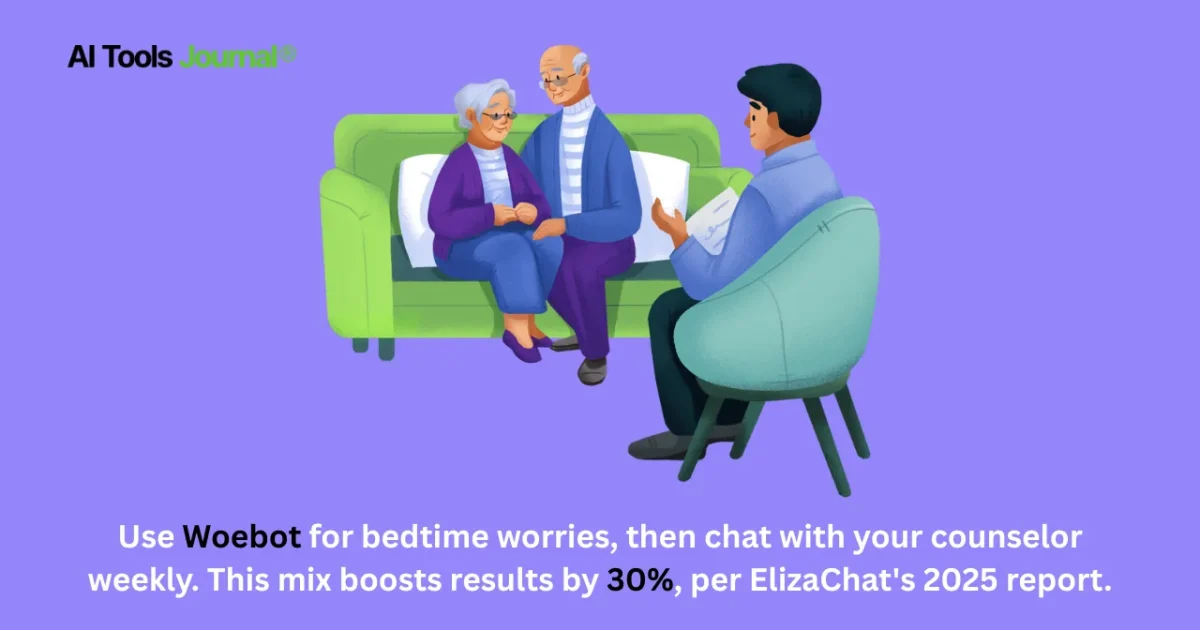
Chatbots like Wysa and Woebot feel safe for teens or shy users.
4. Get help made just for you
AI learns your mood and patterns.
It gives tips that fit what you need.
Top 5 AI Tools for Boosting Mental Health
| Tool Name | Key Feature | Best For | Price/ROI | Cons |
|---|---|---|---|---|
| Wysa | CBT-based chatbot + mood tracker | Anxiety relief + human backup | Saves ~3 hrs therapy weekly; $8/mo | Not a full therapist |
| Woebot | Daily check-ins with CBT skills | Teens with mild anxiety/depression | Cuts mood swings by ~20% in 4 weeks; free | Lacks deeper talk |
| Earkick | Biomarker-tracking LLM companion | Stress tracking, self-care | Cuts stress by ~25%; $15/mo | Needs wearables |
| Talkspace | AI + human licensed therapist | In-depth therapy + notes | Boosts therapy efficiency 200%; $260/mo | Expensive |
| MICA (wearable) | Wearable AI assistant | Seniors with health monitoring | Raises mood check-ins; cost by device | Needs device and cloud |
How to Implement AI Mental Health Tools Effectively: A Practical Guide
- Define your main goal clearly
- Do you want to track mood? Reduce anxiety?
- Choose a tool that fits (Wysa for mood, Earkick for biometrics).
- Start small with a low-risk test
- Try a free tool like Woebot or Wysa’s trial.
- Use it daily for 2 weeks and track how you feel.
- Learn how to prompt the AI right
- Be clear. For example: “I feel stressed because…”
- Ask for help: “Help me calm down.”
- Measure your results weekly
- Keep a journal or use app stats.
- If moods get better, keep going. If not, try another tool.
“Some folk are using AI in self-destructive ways… we must make it a big net positive.”
— Sam Altman, OpenAI CEO PC Gamer
The Future of AI in Mental Health Tools: Trends to Watch in 2025+
- Biometric AI on wearables like MICA can read your pulse and voice.
- AI + Virtual Reality (VR) may let you enter therapy sessions in VR.
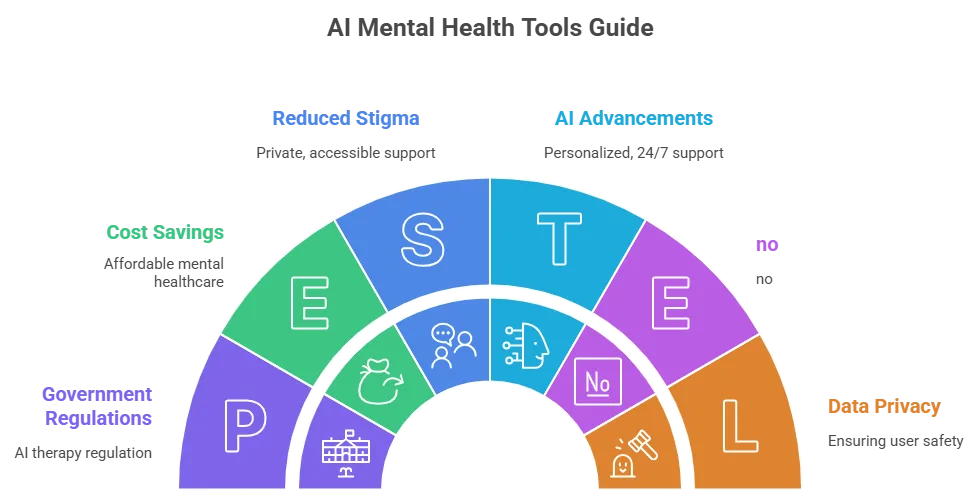
- Smart rules and laws will guide safe use—some places ban AI-only therapy if no human is involved.
Conclusion
AI mental health tools give fast, private, and tailored help. They can save time and money, too. But they work best alongside real human care. Wearables and VR are coming next. This guide helps you pick and use tools wisely. It’s all about feeling better in real life.
FAQs
Will AI take my therapist’s job?
No. AI helps between sessions or guides your self-care. It can’t replace real human empathy.
What if I’m a student and broke?
Use free tools like Woebot or low-cost Wysa. They still help with mood tracking and stress for little or no money.
Are these tools safe for teens?
They can help. But sometimes answers are unsafe. Use under adult watch.